
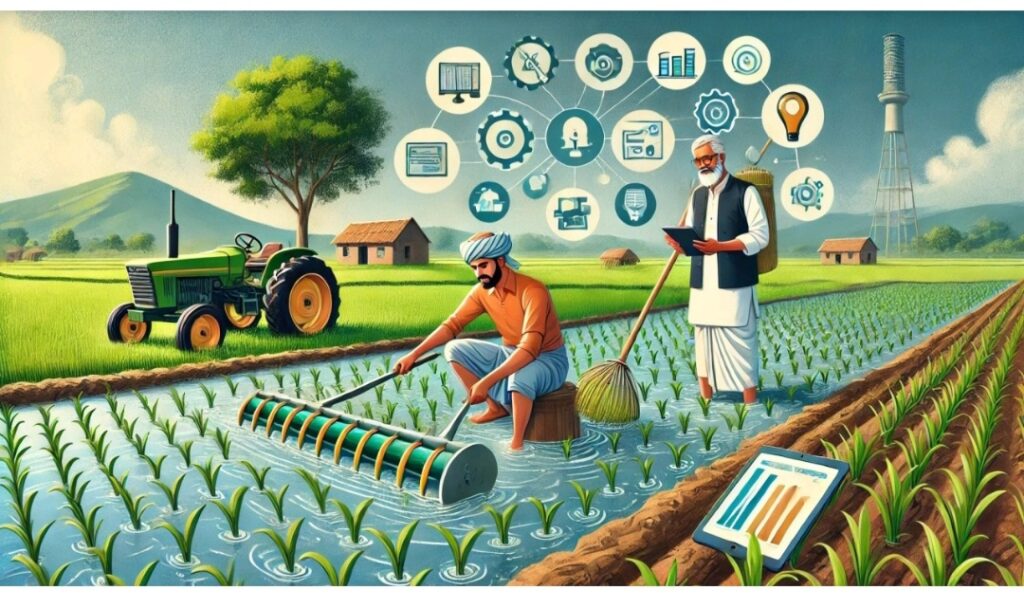
Knowledge is the application of data and information in a practical context. In agriculture, knowledge constitutes a valuable intangible asset for creating and sustaining the level of production, profitability and creating competitive advantages. Knowledge is what farmers and managers use to understand what information means for their particular situation and how they can use it to optimize processes such as planting, irrigation and harvesting etc. This can be achieved through research findings, used to improve yields or applying agronomic principles to maximize profits.
This knowledge from the research findings are usually shared among agricultural stakeholders like farmers so as to make it relevant as a sustainable agricultural practices.
Technology is one of the many factors that affect the sharing of this knowledge in agriculture. The sharing of these knowledge also constitutes a major challenge in the field of knowledge management because some researchers tend to resist sharing their knowledge with the rest of the agricultural stakeholders. They believe that by sharing this knowledge, it may be stolen and used for personal gain, few farmers will also adopt it due to others adamancy. Knowledge management also is supported by tools for sharing and collaboration, such as knowledge management systems and online community forums.
THE MAJOR STAKEHOLDERS IN AGRICULTURAL KNOWLEDGE MANAGEMENT (AKM) AND SHARING (AKS).
The main stakeholders in agricultural knowledge management and sharing include Farmers, Researchers, Extension/Advisory Services, Policymakers, Private Sector (Input Dealers, Marketers, Tech Providers), NGOs/Civil Society, and Educational Institutions, all forming interconnected innovation systems (Agricultural Innovation Systems – AIS) to generate, share, and apply knowledge for better practices and sustainability. Their activities also bridge the gaps between science and practice.
PRIMARY STAKEHOLDERS (DIRECTLY INVOLVED IN KNOWLEDGE FLOW)
The primary stakeholders who are directly involved in knowledge flow include:
i. FARMERS/PRODUCERS: These are the producers of Agricultural produce. They are the ultimate users and source of tacit/practical knowledge. They need access to new information for sustainable production practices and profitability and also sharing their experiences and challenges for better solution.
ii. AGRICULTURAL RESEARCHERS/SCIENTISTS: These are the experts that generate formal and scientific knowledge (for example., develop new crop varieties, pest control options, new breeds of animals etc). They also recieve the experiences and challenges of the farmers and provide solutions to them.
iii. EXTENSION AND ADVISORY SERVICES: These are the agents who crucially link the researchers or scientist with the farmers. They translate the research findings into usable advice to the farmers. They also collect and take the farmers experience, challenges and needs back to the researchers. Thus, they are called extension agents.
SUPPORTING STAKEHOLDERS (FACILITATE AND INFLUENCE)
i. POLICYMAKERS/GOVERNMENT: They are the bureaucractic law makers who create enabling environments for the primary and other stakeholders. They make policies, and provide funding for agricultural development within their country.
ii. PRIVATE SECTOR: These are the stakeholders who pull their personal resources together to produce various inputs required for agricultural production. They range from input suppliers (seeds, fertilizer) to marketers, agribusinesses, and technology developers (ICT) etc.
iii. NGOs AND DEVELOPMENT ORGANIZATIONS: These are the Non Governmental Organizations who implement projects, reach out to remote farmers, and mediate knowledge.
iv. EDUCATIONAL INSTITUTIONS: These are institutions that train future professionals, conduct research, and host learning platforms (For example, agricultural schools where interested individuals in the field of agriculture are trained to aquire knowledge).
Other stakeholders include:
i. FARMER GROUPS/ASSOCIATIONS: These are groups of farmers formed, who collectively share knowledge and advocacy.
ii. MEDIA/INFORMATION BROKERS: These individuals package and disseminate information.
iii. CONSUMERS/FOOD CUSTOMERS: These are the individuals that influence demand of the agricultural produce and also practices in the value chain.
INTERACTION BETWEEN THE STAKEHOLDERS
These groups form Agricultural Innovation Systems (AIS), where collaboration and coordination are vital; for example, researchers develop a new technique and technology, extension agents teach farmers, farmers provide feedback, and private companies supply the inputs needed, all facilitated by digital tools and supportive policies.
REASONS FOR KNOWLEDGE MANAGEMENT
1. IMPROVED PERFORMANCE: Adopting better techniques leads to higher yields and profits.
2. SUSTAINABILITY: Helps address climate change, conserve resources, and ensure long-term food security.
3. INNOVATION: Fosters new solutions by combining diverse knowledge.
4. RESILIENCE: Equips farmers to adapt to changing markets, pests, and environmental conditions.
KNOWLEDGE MANAGEMENT PRACTICES
Some of the practices used during agricultural knowledge management include:
i. CODIFICATION: This is the conversion of practical knowledge into accessible formats like manuals, videos, and fact sheets.
ii. DOCUMENTATION: This is the systematic capture of indigenous knowledge, research findings, and success stories and recorded in a book format.
iii. LEAD BY EXAMPLE: This involve encouragement of leadership to model knowledge sharing behaviours so as to facilitate the adoption of the knowledge by relevant stakeholders.
AGRICULTURAL MANAGEMENT
Agricultural management means systematically planning, operating, and making decisions for farming activities (crops, livestock, resources) to achieve efficient, profitable, and sustainable production, integrating knowledge from economics, science, engineering, and human behaviour to optimize yields and meet market demands, essentially running a farm like a business.
It has also being definited as a broader process encompassing the entire lifecycle of knowledge within the agricultural sector, from creation to application.
Some of the tools used for the management include; digital platforms, farm management systems, extension services, and community networks.
ASPECTS OF AGRICULTURAL MANAGEMENT:
1. PLANNING AND DECISION-MAKING: When farmers want to start their farming business, they decide on what to grow/raise, how much, when, and how, considering market prices, resources, and environmental factors.
2. RESOURCE ALLOCATION: To start the farming business, the farmers will decide on the resources that will enhance the production. These resources could be human and material resources. Efficient use of the resources such as land, water, labor, machinery, seeds, and fertilizers brings about the yield of the agribusiness.
3. PRODUCTION TECHNIQUES: Several production techniques are embacked upon to make the agribusiness a profitable one. These techniques are applied scientific principles for improving soil health, pest/disease control, planting, irrigation, and animal care.
4. ECONOMIC INTEGRATION: This involves the management of finances, understanding market trends, and ensuring profitability from the sales of the produce.
5. SYSTEM INTEGRATION: Agricultural management combines the knowledge from various disciplines like plant science, animal science, engineering, and economics into a holistic cohesive operation that makes the management operation a successful one.
6. GOAL ORIENTATION: Agricultural management manipulate resources to achieve economic goals (profit) while also considering sustainability and food security.
In essence, agricultural management is a holistic action that strategically oversight all farm activities, from planting to harvest and sale, using business principles to maximize output and sustainability, regardless of farm size.
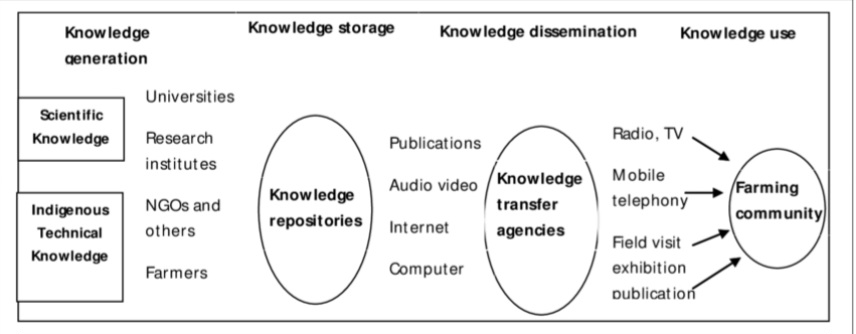
KNOWLEDGE MANAGEMENT IN AGRICULTURE
Knowledge Management started right from the creation of man when they started finding solutions to their problem. This reveals that a clear indication of knowledge resides in people.
Since knowledge resides in people, it must be documented and shared to help decision-making and problem-solving as it is passed on from one generation to the other. As at today, all over the world, KM has been recognised as a cornerstone for the success of any organisation as it enables the identification, capturing, documentation and dissemination of relevant information.
In African and most developing nation’s agriculture sector, it is relatively a new idea which requires a lot of attention to make positive impact. It is a process of realising, identifying a knowledge gap and finding solutions to reduce the struggle by organisations and people from going in circles.
By defination, knowledge Management (KM) in Agriculture is a systematic process for managing an organization’s or community’s knowledge assets to improve decision-making, innovation, and overall performance in agriculture.
KM has also being defined as the process of identifying, creating, capturing, storing, distributing and effectively using knowledge.
It is focused on creating systems for capturing, storage, retrieval, and application of both formal (scientific) and informal (tacit, local) agricultural knowledge. It’s examples include: Establishing digital libraries for crop data, setting up agricultural knowledge centers, creating strategies for documenting best practices, and integrating research findings into extension programs.
PROCESSES INVOLVED IN AGRICULTURAL KNOWLEDGE MANAGEMENT
Agricultural Knowledge Management (AKM) involves processes like capturing (tacit farmer wisdom, research), creating/codifying (turning experience into explicit guides), storing (databases, repositories), sharing/transferring (ICT, extension, farmer-to-farmer), and applying (using knowledge for better decisions), all aimed at boosting innovation, efficiency, and sustainability, often using participatory approaches and technology for stakeholders from farmers to researchers.
The steps involve to achieve the processes include;
a. IDENTIFY NEEDS: Assess specific knowledge gaps and goals.
b. MAP KNOWLEDGE: Understand existing knowledge and where it is lacking.
c. IMPLEMENTATION: Use technology (databases, apps) and human interaction (forums, training).
d. MONITOR AND ADAPTATION: Continuously review and adjust strategies for effectiveness strengthening
Apart from the above processes, some core processes in Agricultural KM include:
i. KNOWLEDGE CREATION AND ACQUISITION: Knowledge can be aquired through capturing /creation. This is achieved by gathering new data, research, and farmer experiences. Some ways of achieving this include:
a. TACIT-TO-EXPLICIT CONVERSION: Converting farmers’ hands-on experience (tacit) into documented best practices (explicit) through workshops and feedback loops.
b. RESEARCH INTEGRATION: Generating new, scientifically validated data and integrating it with local knowledge.
ii. KNOWLEDGE CODIFICATION AND STORAGE: Organization/Storage of knowledge can be done through documentation and structuring of the knowledge ( for example, in digital databases, extension centers).
a. DOCUMENTATION: Recording knowledge in manuals, videos, databases, and case studies to prevent loss and ensure accessibility.
b. REPOSITORY BUILDING: Creating digital platforms (like NARIS systems) to organize and manage agricultural information.
iii. KNOWLEDGE SHARING AND TRANSFER: Sharing /dissemination of done by distributing the knowledge using various platforms listed above.
a. PLATFORMS AND NETWORKS: Using workshops, farmer field schools, online forums, and social media for exchange.
b. EXTENSION SERVICES: Facilitating farmer-to-farmer learning and interaction between farmers, extension officers, and researchers.
c. ICT UTILIZATION: Leveraging mobile apps, web portals, and data systems to disseminate relevant info.
vi. KNOWLEDGE APPLICATION AND UTILIZATION: Application/Utilization of knowledge means putting knowledge into practice on farms for better results ( for example, precision farming, new varieties).
a. INFORMED DECISION-MAKING: Applying data (for example., pest, climate) and research findings to optimize planting, irrigation, and harvesting.
b. INNOVATION: Using shared knowledge to develop new techniques and improve yields.
These processes form a cycle, ensuring that valuable agricultural insights are captured, preserved, spread, and used effectively for sustainable development.
KNOWLEDGE MANAGEMENT IN AGRICULTURE USING THE DATA-INFORMATION-KNOWLEDGE-WISDOM (DIKW)
Nowadays, the quest to resolve the challenges of global agriculture has being under serious debate. Some of these global challenges, whether it is the need to increase food production while reducing inputs, or the need to better understand complex processes and changing market demands need urgent resolution. To overcome these challenges effectively, it is crucial to understand the relationship between data, information and knowledge and to use them to manage farms and agriculture as a whole. This can simply be stated as:
Data-Information-Knowledge-Wisdom (DIKW).
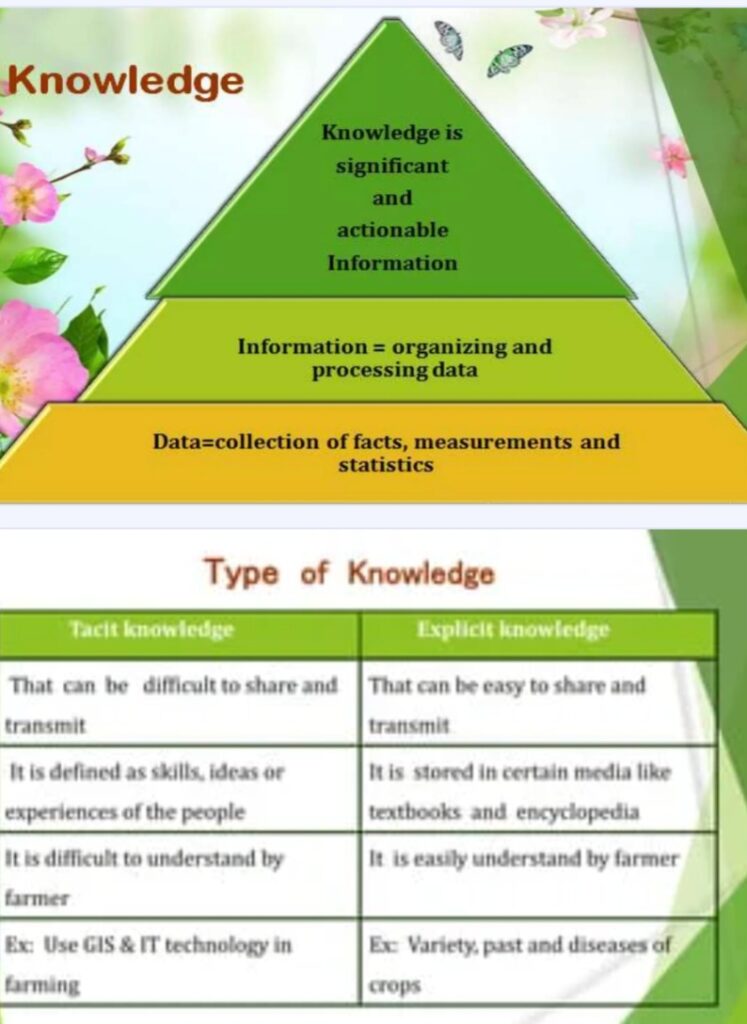
DIKW is a model used to understand the relationships between data, information, knowledge and wisdom. In the context of agriculture, it is an hierachial relationship used in farm management. This hierarchy helps to decipher how raw data is transformed into valuable information that can be used to generate knowledge for informed decision-making and ultimately lead to wisdom for strategic planning and long-term sustainability.
a. DATA MANAGEMENT: Data management deals with the acquisition, storage and maintenance of data. In agriculture, this includes many aspects such as collecting data from field monitors, satellite imagery and weather sensors. Data can include everything from soil temperature, rainfall, crop data to market prices. Tools such as databases and data management systems are the key tools for information management.
b. INFORMATION MANAGEMENT: Information is data processed in a way that is useful and meaningful. In information processing, data is filtered, sorted and analysed so that it can be used for specific purposes. In agriculture, this might mean translating pest occurrence data on maps into pest control strategies or using historical climate data to predict the best times for planting. Information systems and analytical tools play a major role in information management.
c. KNOWLEDGE MANAGEMENT: Knowledge is the application of data and information in a practical context. Knowledge is what farmers and managers use to understand what information means for their particular situation and how they can use it to optimize processes such as planting, irrigation and harvesting. This can include using research findings to improve yields or applying agronomic principles to maximize profits. Knowledge management is supported by tools for sharing and collaboration, such as knowledge management systems and online community forums.
d. AWARENESS: Wisdom or awareness is the highest level in the DIKW hierarchy, where individuals or organizations use their knowledge and experience to evaluate and understand the context in order to make long-term and sustainable decisions. In agriculture, this refers to the ability of farmers and decision makers to see the long-term picture and plan accordingly, for example when considering the impacts of climate change or when converting to organic farming methods.
This contextual DIKW model assist farm managers to proffer solutions to challenges faced in agribusiness such as the need to increase food production while reducing inputs and adapting to a changing market. They use their understanding about data to convert these data into information, which in turn they converted into knowledge and wisdom for better farm management. Digital technologies such as Farm Management Systems, Precision Agriculture and other innovative tools play a key role in this process. Understanding and using the DIKW hierarchy in agriculture can lead to better decision-making and more efficient and sustainable farming, which is in line with the sustainable development goals (SDGs) and global efforts for sustainable agricultural development.
STRATEGIES OF KMA
Knowledge Management (KM) strategies in agriculture focus on capturing, sharing, and applying knowledge from diverse sources (farmers, researchers, tech) through platforms like digital forums, training, and databases. Various methods like expert systems and ICT for better decision-making, documenting indigenous wisdom, and building collaboration for sustainable practices and improved livelihoods are used to addressing unique challenges like stakeholder diversity and informal learning in knowledge management in agriculture.
MAJOR KM STRATEGIES IN AGRICULTURE
i. KNOWLEDGE CREATION AND CAPTURING:
a. DOCUMENTATION: This involves capturing and recording of research findings, best practices, and indigenous/experiential knowledge (case studies, manuals, videos).
b. IDEAS MANAGEMENT: This is a systems for generating and managing new ideas.
c. DATA MINING: Analyzing grower problem databases to find best solutions.
ii. KNOWLEDGE STORAGE AND ORGANIZATION:
a. DIGITAL REPOSITORIES: Creating national/regional databases and e-resources (NARIS, ICAR) for easy accessibility.
b. STRUCTURED SYSTEMS: Organizing information (For example., pest data into control strategies) using analytical tools.
iii. KNOWLEDGE SHARING AND DISTRIBUTION:
a. PLATFORMS: This is a learning forums, social media, workshops, and field demos whereby learning is carried out by farmer-to-farmer and expert-to-farmer learning processes.
b. ICT INTEGRATION: This involves the leveraging of internet, web tech, and mobile apps to bridge the digital divide.
c. MEDIA PRODUCTION: Developing various print, electronic, and web content tailored to user needs so as to facilitate knowledge aquisition.
iv. KNOWLEDGE APPLICATION AND
INNOVATION:
a. EXPERT SYSTEMS: Experts in the field of agriculture develops technology-based tools for crop management and resource conservation practices.
b. DECISION SUPPORT: This involves the translation of data into actionable insights for planting, irrigation, etc..
v. POLICY AND FRAMEWORKS: This involves the establishment of knowledge management policies within research and extension systems.
CHALLENGES IN AGRICULTURAL KNOWLEDGE MANAGEMENT (KM)
i. Challenges in agricultural KM include; poor ICT infrastructure, lack of funding/training for extension workers, stakeholder heterogeneity (research vs. farmer knowledge), resistance to new methods, data silos, and difficulty accessing/sharing relevant, timely information, especially for deskless farmers dealing with climate change and market volatility.
Bridging the gap between formal research and farmers’ indigenous knowledge is crucial but complex. It requirs better linkage and culturally appropriate dissemination of the knowledge.
ii. INFRASTRUCTURE AND RESOURCES
a. POOR ICT AND CONNECTIVITY: Lack of social amenities like internet, electricity, and devices in rural areas limits digital KM.
b. INADEQUATE FUNDING: Insufficient budgets for KM programs hinder development and effectiveness.
c. LACK OF TRAINING: Extension workers often lack KM skills, creating a cycle of underdevelopment.
iii. KNOWLEDGE AND INFORMATION FLOW
a. DATA SILOS: Information is fragmented across research, extension, and farmers, hindering comprehensive sharing.
b. TACIT KNOWLEDGE EXCLUSION: Formal systems often overlook valuable, uncodified farmer knowledge (tacit/indigenous knowledge).
c. RELEVANCE AND USABILITY: Information is not always tailored, timely, or easy for farmers to find and use.
d. RESEARCH-EXTENSION DIVIDE: Traditional, top-down approaches fail to integrate with farmer needs and local contexts.
iii. CULTURAL AND SOCIAL BARRIERS
a. RESISTANCE TO CHANGE: Farmers and workers may resist shifting from traditional to KM-driven systems.
b. STAKEHOLDER HETEROGENEITY: Diverse actors (researchers, policymakers, farmers) have different knowledge systems and power dynamics.
c. GENDER BIAS: Women, who perform significant agricultural labor, are often excluded from knowledge dissemination.
iv. SYSTEMIC AND CONTEXTUAL ISSUES
a. CLIMATE CHANGE: Unpredictable weather requires rapid access to new knowledge, a major KM challenge.
b. MARKET VOLATILITY: Farmers need real-time market data, but struggle to access it.
c. WEAK LINKAGES: Poor connection between research, extension, and farmers (the R-E-U system) slows technology adoption.
v. MAJOR SOLUTIONS AND NEEDS
a. CAPACITY BUILDING: Training for all stakeholders.
b. PARTICIPATORY APPROACHES: Involving farmers in knowledge creation and dissemination.
c. TECHNOLOGY INTEGRATION: Using appropriate ICT and traditional channels (folklore, print).
d. POLICY SUPPORT: Ensuring leadership buys into KM and provides budgets.
B. KNOWLEDGE SHARING IN AGRICULTURE
Knowledge sharing in agriculture is the process where farmers, researchers, and experts exchange information, experiences, and skills to improve farming practices, boost productivity, and find solutions to challenges like climate change or implementing new techniques, leveraging both formal channels (workshops, extension services) and informal ones (farmer-to-farmer exchange) for sustainable development.
It can also be defined as the active exchange of ideas, skills, experiences, and information (formal and informal) between individuals and groups, like farmers sharing crop tips or researchers disseminating new techniques. Another definition states that Knowledge Sharing (KS) in Agriculture is the specific act of transferring, communicating, and disseminating knowledge from one party to another.
Knowledge sharing can also be defined as the process of exchanging information, ideas, insights, and experiences between individuals or teams within an organization.
It focuses on the flow and exchange of ideas, experiences, and information between individuals and groups (farmers, extensionists, researchers), with its goal is to collectively build understanding, solve problems, and adopt better methods for improved output and sustainability.
It is a process whereby various stakeholders in the agricultural sector learn from each other and experts adopt better methods, from regenerative agriculture to quality standards, fostering innovation and efficiency in the sector.
The stakeholders such as farmers, extension workers, scientists, and policymakers exchange and share knowledge through different communication methods to achieve their goals. The types of Knowledge shared includes; practical “know-how,” tacit knowledge (hard to codify), best practices, and scientific research knowledge.
Examples of KSA include: Workshops, field days, online forums, farmer-to-farmer networks, extension officer visits, and community discussions.
Knowledge sharing can occur through various methods such as conversations, mentoring, training programs, and digital platforms. The key is to ensure that knowledge is easily accessible and disseminated to those who need it, ultimately fostering innovation, collaboration, and growth.
REASONS FOR KNOWLEDGE SHARING IN AGRICULTURE
Reasons for knowledge sharing in agriculture include boosting productivity, resilience, and income. These are achieved by disseminating new techniques, adapting to climate change, and improving decision-making, especially through farmer-to-farmer networks that blend local wisdom with science for sustainable practices and better market access. These ultimately ensure food security and community growth.
1. BRIDGING GAPS: Connects isolated rural dwellers with vital information.
2. CONTEXTUALIZATION: Adapts global knowledge to local conditions (climate, soil, economy).
3. EMPOWERMENT: Builds capacity and trust within farming communities.
4. SUSTAINABILITY: Drives sustainable and resilient farming practices.
5. STRENGTHENING
Other major Reasons for Knowledge Sharing:
6. ENHANCING PRACTICES AND PRODUCTIVITY: Sharing new techniques, technologies, and data helps farmers improve efficiency, reduce costs, and increase yields.
7. CLIMATE CHANGE ADAPTATION: Co-creating and sharing knowledge is vital for developing and implementing agroecological innovations to adapt to climate challenges.
8. IMPROVING LIVELIHOODS: Increased productivity and market alignment (connecting with buyers) directly boost farm income and economic stability.
9. BUILDING RESILIENCE: Farmer-to-farmer networks strengthen community resilience by sharing localized solutions and pooling experiences.
10. BETTER DECISION-MAKING: Converting data into knowledge and wisdom enables smarter, more sustainable long-term farm management.
11. INNOVATION AND ADOPTION: Spreading awareness of regenerative and new methods encourages wider adoption, fostering innovation in farming.
12. BRIDGING GAPS: Knowledge sharing fills gaps where formal extension services are limited, leveraging farmers’ practical, context-specific knowledge.
13. SUSTAINABLE DEVELOPMENT: It promotes sustainable practices, reduces waste, and aligns agriculture with global goals like the Sustainable Development Goals (SDGs).
14. COMMUNITY AND TRUST: Participatory processes build trust and foster collaboration, crucial for successful transitions in farming.
PURPOSE OF KNOWLEDGE SHARING IN AGRICULTURE.
The purpose of knowledge sharing in agriculture is to enhance productivity, improve sustainability, boost resilience, and empower farmers by disseminating best practices, innovations, and localized wisdom, blending traditional, scientific, and practical experience to solve challenges, optimize processes (planting, irrigation, harvesting), build stronger communities, and achieve food security goals. It helps adapt to climate change, adopt new techniques like regenerative farming, and ensures crucial information isn’t lost, making agriculture more efficient and sustainable.
1. Increase adoption of new methods (e.g., regenerative agriculture).
2. Enhance production and quality standards.
3. Address challenges like climate change.
4. Promote innovation and modernization.
a. IMPROVE FARMING PRACTICES: Sharing insights helps farmers adopt more effective, efficient, and sustainable methods, leading to better yields and reduced costs.
b. ADAPT TO CLIMATE CHANGE: Co-creating knowledge allows for blending local wisdom with science to develop context-specific solutions for changing environments.
c. BUILD RESILIENCE: Strong knowledge networks (farmer-to-farmer) bolster community capacity to handle shocks and uncertainties, fostering self-reliance.
d. PROMOTE SUSTAINABLE AGRICULTURE: It’s vital for spreading regenerative and agroecological practices that protect the environment.
e. OPTIMIZE RESOURCE USE: Sharing knowledge on irrigation, planting, and harvesting helps farmers make data-driven decisions for better outcomes.
f. EMPOWER FARMERS: Equips farmers with practical advice, new technologies (like digital apps), and the confidence to innovate and manage their farms better.
g. DRIVE INNOVATION: Connects scientific research with on-the-ground realities, fostering co-creation of relevant agricultural innovations.
h. ENSURE FOOD SECURITY: By improving overall agricultural efficiency and resilience, knowledge sharing directly supports global efforts to end hunger and malnutrition.
BENEFITS OF KNOWLEDGE SHARING
Knowledge sharing is a powerful tool that organizations can use to foster a culture of openness and collaboration. It involves sharing information, skills, and expertise among the various agricultural stakeholders to enhance performance, innovation, and consumer satisfaction.
When the stakeholders embrace knowledge sharing, they can reap numerous benefits. Some of the key benefits of knowledge sharing include:
1. FACILITATING KNOWLEDGE SHARING BETWEEN TEAMS: Team members in the agribusiness and stakeholders will have access to knowledge from the knowledge shared within their groups and during training to help improve on their production practices.
2. INCREASED PRODUCTIVITY AND INCOME: Sharing knowledge on superior seeds, efficient land use, and processing leads to higher yields and better product quality, directly boosting farmer income.
3. ADOPTION OF INNOVATION: Spreads awareness and skills for new methods, from regenerative farming to precision agriculture, helping farmers adapt to changing environments.
4. RESILIENCE AND SUSTAINABILITY: Strengthens communities by building local capacity, preserving indigenous knowledge, and promoting sustainable practices like water harvesting.
5. ENHANCED DECISION-MAKING:
Knowledge sharing provides access to relevant information and insights, which can help teams make better decisions. When members of the agristakeholders have access to a wealth of knowledge, they can make informed decisions that align with the agribusiness goals and objectives.
For example, they collate and convert data into wisdom, enabling long-term planning for issues like climate change and market demands, as noted in SmartAfriHub.
1. FASTER PROBLEM-SOLVING: Knowledge sharing enables teams to draw on shared experiences and expertise to solve problems quickly. By collaborating and sharing knowledge, employees can avoid reinventing the wheel and find solutions more efficiently.
2. INCREASED INNOVATION: When teams share ideas and knowledge, they can build upon each other’s work to create innovative solutions. Knowledge sharing can spark creativity and lead to breakthroughs that might not have been possible otherwise.
3. REDUCED RISKS ASSOCIATED WITH KNOWLEDGE LOSS: When experts and professionals or those trained to facilitate knowledge sharing in the field leave the field of agriculture or any organization partaking as an agri stakeholder, they take their knowledge and expertise with them. But through knowledge sharing, capturing and documenting of these knowledge are achieved, reducing the risks associated with losing critical information when departure occurs.
4. BETTER MARKET ACCESS: Data sharing connects farmers to buyers, helps align production with demand, reduces waste, and improves profitability, notes ishare.eu.
5. COST REDUCTION: Sharing information on inputs and techniques helps lower operational costs.
6. EMPOWERED COMMUNITIES: Farmer-to-farmer networks are often more effective than traditional top-down extension, empowering local groups with relevant, place-based solutions, say FAO and ipam-global.org.
7. ENHANCED EMPLOYEE SATISFACTION AND RETENTION: When employees feel valued and engaged, they are more likely to stay with an organization. Knowledge sharing can help to create a positive work environment where employees feel empowered and supported.
8. LEVELING UP: Implementing a Knowledge-Sharing Culture (will further be discussed below)
9. IMPLEMENTING KNOWLEDGE SHARING SYSTEMS:
To maximize the benefits of knowledge sharing, organizations must be intentional about creating and implementing effective strategies. This includes providing employees with the tools and resources they need to share knowledge, recognizing and rewarding knowledge-sharing behaviors, and fostering a culture of collaboration and openness.
METHODS OF SHARING KNOWLEDGE
Knowledge sharing in agriculture can be achieved through workshops, field days, online forums, social media groups, farmer-to-farmer learning, and demonstration plots.
1. FARMER-TO-FARMER: Farmer-to-farmer networks (peer learning), farmer field schools, study tours, community groups.
2. FORMAL: Workshops, training, online platforms (like FAO’s AGRIS), research bodies providing access to data and journals.
3. INFORMAL: Social networks, sharing experiences directly.
4. Agricultural extension services
5. DIGITAL PLATFORMS AND DATA SHARING:
Digital Platforms like Apps (WhatsApp, YouTube) for quick advice.
6. Co-creation involving science, indigenous, and practical knowledge
7. Formal and non-formal education
8. Informal learning, work groups, and storytelling.
9. PARTICIPATORY APPROACHES: Blending scientific, indigenous, and producer knowledge (agroecology).
TOOLS USED FOR SHARING KNOWLEDGE
Apart from traditional face-to-face knowledge sharing, social media is a good tool because it is convenient, efficient, and widely used.
In the digital world, websites and mobile applications enable knowledge or talent sharing between individuals and/or within teams.
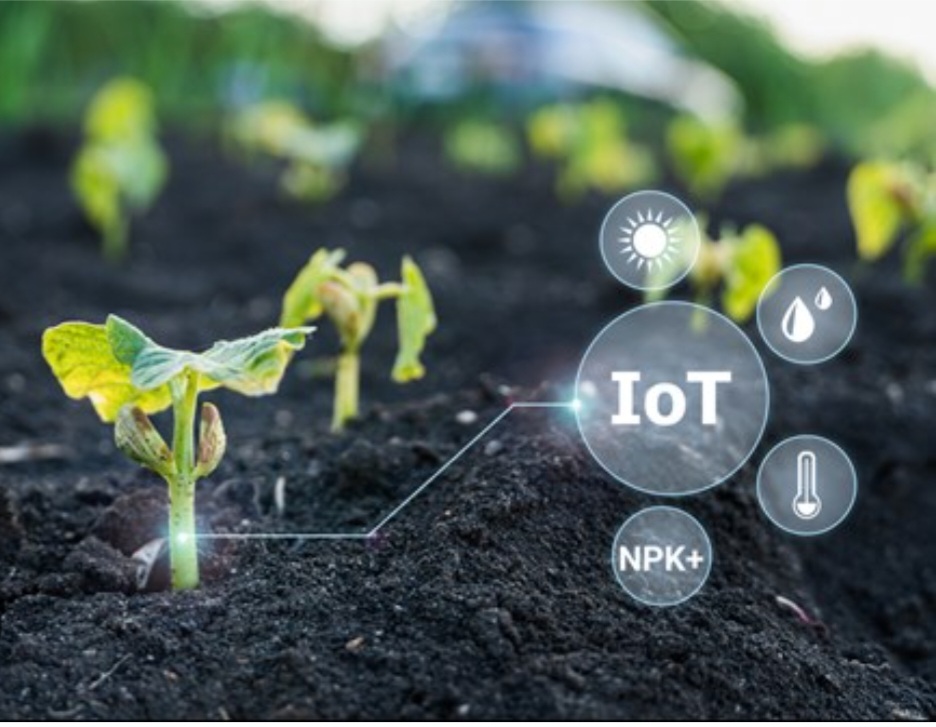
Today, IoT services has being included as an easy means of sharing knowledge among people and agricultural stakeholders. The individuals can easily reach the people who want to learn and share their talent to get rewarded.
INFORMATION TECHNOLOGY SYSTEMS (IT): These are common tools that help facilitate knowledge sharing and knowledge management. The main role of IT systems is to help people share knowledge through common platforms and electronic storage to help make access simpler, encouraging economic reuse of knowledge. IT systems can provide codification, personalization, electronic repositories for information and can help people locate each other to communicate directly. With appropriate training and education, IT systems can make it easier for organizations to acquire, store or disseminate knowledge.
FACTORS AFFECTING KNOWLEDGE SHARING
Knowledge is transferred among agricultural stakeholders who are expert in the field of agriculture. These experts design a structural strategy for knowledge transfer so that the agribusiness can thrive.
Several factors affect knowledge sharing in agribusiness, such factors include; agribusiness culture, trust, incentives, individual motivations (trust, self-efficacy, perceived benefits), social & cultural elements (farmer group participation, social networks, trust, organizational culture), technology and infrastructure (ICT access, internet, IT support), and extension services (accessibility, quality, training), with economic factors like farm income also playing a role in willingness to share.
In agribusiness, five distinct conditions of the agribusiness culture have a positive effect on knowledge-sharing:
i. communication and coordination between groups,
ii. trust,
iii. top management support,
iv. the reward system, and
v. openness.
i. COMMUNICATION AND COORDINATION: Concerning the communication and coordination between groups that make up the stakeholders, stakeholder structure encourages knowledge-sharing. For example, researchers pass their findings to extension agents who desseminate the findings to onsite farmers to test the findings. When a profitable result is achieved, trust is built among the stakeholders, especially farmers.
KNOWLEDGE MANAGEMENT SYSTEMS AS A FORM OF INFORMATION TECHNOLOGY
Drivers for knowledge sharing are connected to both human resources and software. Knowledge sharing activities are commonly supported by knowledge management systems, a form of information technology (IT) that facilitates and organizes information among the agricultural stakeholders. Knowledge sharing in knowledge management systems can be driven by accountability-inducing management practices. The combination of evaluation and reward as an accountability-inducing management practice has been presented as and effective way for enhancing knowledge sharing.
1. ECONOMIC FACTORS: Farm income plays a role in willingness to share.
2. INDIVIDUAL AND PSYCHOLOGICAL FACTORS
a. MOTIVATION: Expectation of returns, financial benefits, and access to resources drive sharing can moltivate individual members of the stakeholders.
b. SELF-EFFICACY: Belief in one’s ability to share knowledge without hesitation.
c. TRUST: Trust in others’ abilities (ability, benevolence, integrity) encourages sharing.
d. ATTITUDE: Positive attitude towards sharing is crucial.
3. SOCIAL AND CULTURAL FACTORS
a. FARMER GROUPS: farmers coming together to form a group has a lot of advantages. Their participation in the groups facilitates knowledge exchange among the group members.
b. SOCIAL NETWORKS: Strong networks and relational capital promote sharing and collective learning.
c. ORGANIZATIONAL CULTURE: A culture that values collaboration and provides platforms for sharing.
d. COLLECTIVIST VALUES: A sense of community and reciprocity.
4. TECHNOLOGY AND INFRASTRUCTURE
a. ICT ACCESS AND USAGE: Availability and knowledge of Information and Communication Technologies (smartphones, internet).
b. IT INFRASTRUCTURE: Supportive IT systems within organizations.
5. EXTENSION AND INSTITUTIONAL SUPPORT
a. EXTENSION SERVICES: Extension agents are responsible for transmitting research findings to farmers. In a reciprocal manner, the experiences and challenges of the farmers are relayed back to the reseachers to proffer solution.
Therefore, this facilitate a quality and accessible agricultural extension services.
b. TRAINING: As new technologies and practices in agriculture continues to emerge, consistent training of extensionist should be carried out to update their knowledge for effective knowledge sharing.
c. LEADERSHIP AND MANAGEMENT: Support from senior management for knowledge sharing initiatives.
5. KNOWLEDGE AND CONTENT CHARACTERISTICS
Nature of Knowledge: Tacit (experiential) vs. explicit (documented) knowledge, and its perceived usefulness.
Economic Factors
Farm Income: Higher income can influence participation and willingness to invest in knowledge.
Affordability: Cost of communication and technology.
KNOWLEDGE SHARING STRATEGIES (STRATEGIES OF KSA )
Effective agricultural knowledge sharing strategies blend digital tools (apps, social media, online forums) with traditional methods (farmer field schools, workshops, study tours) to connect diverse stakeholders like farmers, researchers, and extension agents, focusing on peer-to-peer learning, documenting indigenous knowledge, and creating collaborative environments through partnerships and community groups for innovation and productivity.
To create a successful knowledge-sharing strategy among agricultural stakeholders, the following can be embacked upon:
1. Developing an effective knowledge-sharing strategy is crucial for any agribusiness that wants to stay competitive in today’s fast-paced business environment. Sharing knowledge can help improve on the agribusiness processes, increase innovation, and ultimately achieve their goals more efficiently.
2. FOSTER A LEARNING CULTURE: In addition to encouraging openness and trust, it is important to create a culture that values learning and continuous improvement because knowledgeisnot static, new discoveries are made every day. This means providing opportunities for farmers, extension agents, indirect farmers etc to learn and develop new skills so as to upgrade their knowledge and recognizing and rewarding those who share their knowledge and expertise.
3. USE STORYTELLING TO SHARE KNOWLEDGE: Stories are a powerful way to convey information and engage people emotionally. Encourage experts and professionals to share stories about their experiences, successes, and failures, and use these stories to illustrate key concepts and best practices will bring about motivation, encouragment and trust.
4. PROVIDE TRAINING AND SUPPORT: While some experts and professionals may be natural knowledge sharers, others may need guidance and support to get started. Providing training and resources on effective communication, collaboration, and knowledge management can help ensure that everyone is equipped to participate in the knowledge sharing process.
5. ENCOURAGE CROSS-FUNCTIONAL COLLABORATION: Knowledge sharing should not be limited to within teams or departments. Encouraging collaboration across different functions and agribusiness units can help break down silos and promote a more holistic view of the knowledge sharing goals and challenges.
6. MEASURE AND TRACK PROGRESS: To ensure that knowledge sharing strategy is effective, it is important to measure and track progress over time. This can include tracking metrics such as the number of knowledge sharing activities, the level of engagement among farmers, and the impact on major business outcomes. This are usually done by extension agents and some other supporting stakeholders.
By following these, knowledge sharing strategies can be created and not only help achieve its goals. It also fosters a culture of learning, collaboration, and continuous improvement.
Some of the strategies used to share knowledge include the following:
i. DIGITAL AND TECH-BASED STRATEGIES
a. MOBILE Apps AND SOCIAL MEDIA: Stakeholders utilize platforms like WhatsApp, YouTube, and specialized apps for quick Q and A, video sharing, and building virtual communities in local languages to disseminate knowledge among themselves.
b. ONLINE FORUMS AND DATABASES: Stakeholders can create digital hubs for sharing research knowledge, best practices, and success stories, making information easily searchable.
c. AI CHATBOTS: Implement AI like IoT for immediate, context-specific answers to farmer queries.
ii. COMMUNITY AND PEER-TO-PEER STRATEGIES
a. FARMER FIELD SCHOOLS AND GROUPS: Stakeholders can establish community-based learning centers, create work teams, and study tours for hands-on, experiential learning.
b. STORYTELLING AND SEED SHARING: Organization’s of events can be done to celebrate and share traditional knowledge from elders and women. Experiences and knowledge gained from co- stakeholders and theirs can be a motivating information.
c. NETWORKS AND ASSOCIATIONS: AKS can foster farmers’ associations and peer-to-peer networks for collaborative problem-solving.
iv. INSTITUTIONAL AND PARTNERSHIP STRATEGIES
a. STRENGTHEN EXTENSION SERVICES: AKS can empower extension officers with training and workshops and provision of tools to facilitate knowledge flow.
b. STAKEHOLDER PARTNERSHIPS: Stakeholders partinaship can form collaborations between government, NGOs, researchers, and farming communities to share resources.
c. KNOWLEDGE FAIRS: Through organization of different events for stakeholders, exchange of ideas and innovations can be possible, thus, syrnghtening and achie v ing the goals of Agricultural knowledge sharing.
FACILITATING KNOWLEDGE SHARING BETWEEN TEAMS
Sharing knowledge between teams is crucial for agribusiness to stay productive, profitable, competitive and innovative. It facilitate a blend of social interactions, a supportive culture, and appropriate technology to integrate farmers’ practical experience with scientific knowledge. The most effective strategies utilize a mix of face-to-face methods and digital tools.
Here are some tips to help promote knowledge sharing between the stakeholders:
1. Create opportunities for cross-team collaboration through joint projects, workshops, and other initiatives to stimulate interdisciplinary knowledge exchange
2. Promote a culture of learning by celebrating and rewarding knowledge sharing, and recognizing members who actively contribute to the collective knowledge pool. This can be done through regular team meetings, where team members can share their knowledge and expertise, or through an internal newsletter that highlights successful knowledge-sharing stories.
3. Implement training programs that emphasize the importance of knowledge sharing and provide practical guidance on sharing techniques. These programs can include workshops, seminars, and online courses that teaches the agricultural stakeholder how to share their knowledge effectively and efficiently.
4. Encourage the use of collaboration tools, such as instant messaging and project management platforms, to streamline communication channels between team members. This can help facilitate real-time knowledge sharing and make it easier for team members to connect and collaborate with each other.
By following these tips, agribusiness can create a culture of knowledge sharing that fosters innovation, creativity, and collaboration. With the right facilitation, knowledge sharing can become an integral part of an organization’s and agribusiness day-to-day operations.
5. In addition to the above, it is important to create a safe and supportive environment for knowledge sharing. This means ensuring that team members feel comfortable sharing their knowledge and ideas without fear of judgment or retribution. It is also important to recognize that knowledge sharing is a two-way street – team members should be encouraged to both share their own knowledge and seek out knowledge from others.
6. Another way to promote knowledge sharing is through mentorship programs, where experienced team members can share their knowledge and expertise with newer team members. This can help build relationships between team members and create a sense of community within the organization.
Finally, it is important to measure the success of knowledge sharing initiatives. This can be done through regular surveys, feedback sessions, or by tracking the adoption of knowledge sharing tools and techniques. By measuring success, organizations can identify areas for improvement and refine their knowledge sharing strategies over time.
METHODS AND STARTEGIES USED TO FACILITATING KNOWLEDGE SHARING
Some major strategies and methods used to facilitate Knowledge sharing in Agriculture include:
a. ESTABLISH COMMUNITIES OF PRACTICE (CoPs): Encourage the formation of formal and informal farmer groups, networks, and associations where individuals can exchange ideas and learn from peers who face similar challenges. Trust within these networks is a major factor in the willingness to share knowledge.
b. IMPLEMENT PARTICIPATORY LEARNING PROGRAMS: Programs like Farmer Field Schools and on-farm experimentation allow farmers to gain knowledge and test new practices in their own context, which significantly increases adoption rates.
c. STRENGTHEN EXTENSION SERVICES: Agricultural extension officers act as crucial intermediaries between farmers, researchers, and government authorities. They can facilitate workshops, training programs, and provide on-farm demonstrations.
d. LEVERAGE DIGITAL PLATFORMS: Utilize technology to overcome geographical barriers and provide timely information.
-Mobile-based applications for real-time access to information on weather, pests, and market conditions.
-Online forums and social media groups to connect farmers with experts and each other.
-Knowledge repositories and databases to store explicit -knowledge like research findings, case studies, and manuals in various formats (video, audio, text).
e. INTEGRATE DIVERSE KNOWLEDGE SYSTEMS: Combine local, indigenous, and practical farmer knowledge with formal scientific data to co-create relevant, context-specific solutions.
f. PROMOTE A KNOWLEDGE-SHARING CULTURE: Encourage open communication, recognize contributions to the knowledge base, and ensure leadership support for knowledge management initiatives.
g. ENSURE CONTENT RELEVANCE AND ACCESSIBILITY: Information shared must be relevant to the local context and delivered in easily digestible formats and appropriate languages. Avoid overly complex systems or “scientific” jargon.
LEVELING UP ( IMPLEMENTING A KNOWLEDGE-SHARING CULTURE)
Creating the agribusiness culture of knowledge sharing extends beyond just production, processes and tools. It requires a shift in mindset and attitudes. The following are some steps to foster a knowledge-sharing culture:
i. LEAD BY EXAMPLE: Farm owners and their managers should actively engage in knowledge sharing, demonstrating their commitment to the process and encouraging others to follow suit.
ii. EMBRACE DIVERSITY AND INCLUSION: Encourage all farmers, experts and professionals from all backgrounds with different levels of experience to contribute their knowledge and expertise, recognizing that diverse perspectives enrich the collective understanding.
iii. SHARE SUCCESSES AND FAILURES: Promote a learning orientation by openly discussing both positive and negative experiences, fostering resilience and growth.
iv. ALLOCATE TIME AND RESOURCES: Provide all farm workers with the necessary resources and dedicated time to engage in knowledge sharing activities.
IMPLEMENTING KNOWLEDGE SHARING SYSTEMS
Investing in tools and systems that facilitate knowledge sharing is essential for creating an effective knowledge sharing environment. Some popular options include:
i. INTRANETS: Internal websites for sharing news, documents, and resources
ii. DOCUMENT MANAGEMENT SYSTEMS: Platforms for storing, organizing, and retrieving digital documents
iii. KNOWLEDGE MANAGEMENT SYSTEMS (KMS): Comprehensive platforms that capture, store, and share organizational knowledge
iv. COLLABORATION TOOLS: Online platforms that support group communication and project coordination
By providing the right infrastructure for knowledge sharing, shareholders in agribusiness can improve the flow of information and enhance overall productivity.
CHALLENGES OF KNOWLEDGE SHARING
Knowledge sharing can sometimes constitute a major challenge in the field of knowledge management.
However, despite the many benefits of knowledge sharing, it can be challenging to implement in practice. For example, some individuals may be reluctant to share their knowledge due to a fear of losing their competitive advantage or job security. Additionally, knowledge sharing requires a culture of trust and openness, which may not exist in all organizations.
Other challenges in AKS include poor infrastructure (internet access), low digital literacy, resistance to new methods, ineffective extension services, information overload, and disconnects between researchers, extension workers, and farmers, often rooted in power dynamics and a failure to recognize farmers’ own tacit knowledge.
Some of the major issues hindering knowledge sharing include; siloed information, misaligned incentives, and inadequate funding for management systems. All hinder the flow of vital information on new techniques, market prices, and risks.
The difficulty of knowledge sharing resides in the transference of knowledge from one entity to another.
1. FARMER-LEVEL CHALLENGES
a. LACK OF TRUST: Skepticism towards external sources (researchers, companies) and even fellow farmers is one of the major challenges of knowledge sharing among the stakeholders. Most farmers are adamant to adopt new innovations especially those that are not learnered. Also, when research findings are not presented with concrete results, knowledge sharing might prove difficult. Therefore, to promote knowledge sharing and remove mistrust, the farming culture of an entity should encourage discovery and innovation. Members of the stakeholders who trust each other are willing to exchange knowledge and at the same time want to embrace knowledge from other members as well.
b. RESISTANCE TO CHANGE: Farmers can be hesitant to adopt new practices due to tradition or fear of failure. When these adamant farmers understand the value of knowledge sharing, they become motivated to participate
c. INFORMATION OVERLOAD: Too much conflicting or irrelevant data can be overwhelming. By effectively organizing and filtering these data, individuals are prevented from becoming overwhelmed
d. SAFEGUARDING SENSITIVE INFORMATION: Protecting confidential data while still promoting knowledge sharing ensure futuristic relevance of such data
e. MEASURING SUCCESS STORIES: Defining and tracking the ROI of knowledge-sharing initiatives
f. DIGITAL DIVIDE: Poor internet and low literacy in rural areas limit access to digital knowledge.
g. TACIT KNOWLEDGE GAP: Difficulty in formalizing and sharing practical, on-the-ground wisdom.
2. SYSTEMIC AND INSTITUTIONAL CHALLENGES
a. WEAK EXTENSION SERVICES: Extension agents do lack funding to carry out their duties. No or inadequate training of these agents and coordination for extension workers, all prove to limit the efficiency of these agents.
b. RESEARCH-EXTENSION DISCONNECT: Top-down research often fails to address real farmer needs, creating a gap.
c. SILOED EFFORTS: Independent NGOs, researchers, and private sector groups often duplicate work and notes due to some factors that limit their efficiency.
d. POLITICAL AND POWER DYNAMICS: Knowledge networks can serve political agendas, marginalizing some farmers.
e. LACK OF INCENTIVES: Insufficient motivation or rewards can limit the sharing knowledge.
3. TECHNOLOGICAL AND METHODOLOGICAL HURDLES
a. INADEQUATE ICT: There is poor implementation and suitability of technology for local contexts. This is due to lack of social amenities in the rural areas.
b. FLAWED DATA COLLECTION: Most methods used for gathering informations and knowledge are usually incomplete or inaccurate. Thus, flowing data collection on knowledge.
c. COMPLEXITY: Most tools used during knowledge aquisition are complex and complicated for researchers, extensionist and ordinary farmers to use. They need special training to learn how to utilize the tools. The methodologies are also very complex to follow.
d. MISINFORMATION: The spread of false information, especially via social media, can cause confusion.
4. ORGANIZATIONAL BARRIERS (WITHIN INSTITUTIONS)
a. LACK OF COMMITMENT: Insufficient top management support for knowledge management.
b. RESOURCE CONSTRAINTS: No dedicated budget for knowledge management programs.
c. INERTIA: Resistance to recognizing the need for change and urgency in knowledge sharing
SOLUTIONS / OVERCOMING THE CHALLENGES OF KNOWLEDGE SHARING
Knowledge sharing in agriculture boosts productivity, income, and sustainability by spreading best practices, fostering innovation (like digital tools), reducing costs, improving market access, and building resilient communities through farmer-to-farmer learning and data insights, leading to better decision-making for challenges like climate change and food security. It helps adopt new techniques, improves skills, and ensures local, relevant solutions thrive.
In addition, a proactive attitude and strategic planning can be used to address these challenges, Thus, making the shareholders successfully promote knowledge sharing and reap its benefits.
i. COMPETITION : Build a supportive culture through peer mentoring and collaborative activities, not individual competition.
ii. TECHNOLOGICAL BARRIERS: Provide training and support to help stakeholders use digital tools effectively; address poor internet connectivity in remote areas.
iii. KNOWLEDGE SILOS AND FRAGMENTATION: Encourage cross-functional collaboration and use integrated knowledge management systems to connect different stakeholders.
iv. LOSS OF TACIT KNOWLEDGE :Use methods like mentorship programs and in-person interactions (for example., field days) to capture and transfer experience-based know-how etc.
DIFFERENCES BETWEEN KNOWLEDGE MANAGEMENT AND KNOWLEDGE SHARING
Using the public library as an illustration, knowledge management is gathering the books and deciding how to organize them on the shelf. Knowledge sharing is creating the process for how to share those books out to the people who need that information. With this simple illustration, it can be stated that
knowledge sharing and management in agriculture involves a systematically capturing, organizing, sharing, and applying insights (from research, experience, data) among farmers, extension workers, researchers, etc who are stakeholders to improve practices, boost productivity, adapt to challenges like climate change, and ensure sustainable food production and marketing systems. It moves data into actionable knowledge, empowering better farm decisions and enhancing livelihoods.
Knowledge sharing or skill sharing is an activity through which knowledge (namely, information, skills, or expertise) is exchanged among people, friends, peers, families, communities, or within or between organizations. It bridges the individual and organizational knowledge, improving the absorptive and innovation capacity and thus leading to sustained competitive advantage of companies as well as individuals. Knowledge sharing is part of the knowledge management process.
It constitutes a major challenge in the field of knowledge management because some employees tend to resist sharing their knowledge with the rest of the organization.
In agriculture, Knowledge Management (KM) is the broad strategy for capturing, storing, organizing, and using knowledge (like scientific data, local wisdom), while Knowledge Sharing (KS) is a key activity within KM, focusing specifically on the act of exchanging that knowledge (e.g., advice, experiences) between farmers, researchers, and extension agents through platforms like farmer groups or digital tools to improve practices and innovation. Essentially, KM creates the system, and KS is the dynamic interaction that fills and utilizes it, boosting productivity and collaboration.
In summary, the difference between both concept include:
1. Scope: KM is the umbrella strategy (the “what” and “how” of knowledge), while KS is a core component or activity within that strategy (the “doing” of knowledge transfer).
2. Action: KM involves building infrastructure (centers, systems) and processes (documentation); KS involves communication, interaction, and collaboration (sharing, discussing).
3. Goal: KM aims for organizational learning and effectiveness; KS directly fosters collaboration, skill development, and innovation through interaction.
In short, knowledge is managed to create an environment where sharing can effectively take place, and sharing is what brings that managed knowledge to life in the field of agriculture.
TERMINOLOGIES
i. KNOWLEDGE TRANSFER: Deliberately integrating systems, processes, routines, etc., to combine and share relevant knowledge.
ii. COMMUNITIES OF PRACTICE: A group of people who share a craft or a profession; usually takes the form of cross organizational or inter-organizational workgroups, in physical, virtual or blended forms[19]
iii. COMMUNITIES OF INTEREST: Informal and voluntary gathering of individuals discussing on a regular basis, in many cases through defined digital channel
iv. WORKGROUPS: Task-oriented groups that may include project teams or employees from various departments, working and sharing knowledge together towards a specific goal such as product development or production.
v. KNOWLEDGE CAFE: A methodology to conduct knowledge sharing sessions using a combination of a large assembly and of small discussion groups of 3–5 persons, usually around small tables
vi. LESSONS LEARNED TECHNIQUES: Techniques to learn from what has happened before and what could be done better the next time.
vii. MENTORING: A way to share a wide range of knowledge from technical values to technical and operational skills. Through mentoring programs, it is possible to share tacit norms of behaviour and cultural values.
viii. CHATS: Informal sharing, using instant messaging platforms. The knowledge is accessible mainly in the present or by search.
ix. WIKIS: Digital spaces for gathering and sharing knowledge asynchronously on specific topics. Wiki pages link across topics to form an intuitive network of accumulated knowledge, using categories as a means of organizing the information.
x. STORYTELLING: An informal way to share knowledge, where knowledge owner shares real life stories to other.
xi. SHARED KNOWLEDGE BASES: Shared organized content, containing information and knowledge. Can be formed as websites, intranets databases, file drives, comprehensive models based on probabilistic-causal relationships or any other form that enables the access to content by the various individuals.
xii. EXPERT MAPS: Organized lists or network of experts and corresponding expertise. Enables indirect access to the knowledge (through the expert).
xiii. STAKEHOLDER HETEROGENEITY: Managing diverse needs of farmers, researchers, extension agents, etc..
xiv. INFORMAL CONTEXTS: Valuing and integrating informal learning and indigenous knowledge alongside formal science.
xv. CAPACITY BUILDING: Training farmers and extension workers in ICT and KM tools.
xvi. COLLABORATION: Fostering networks between institutes, universities, and farmers (NARS, ICAR).
xvii. STAKEHOLDER COLLABORATION: Involving farmers, researchers, and policymakers in a participatory way.
xviii. CAPACITY BUILDING: Training stakeholders in KM strategies and digital tools.
xix. MONITORING AND EVALUATION (M&E): Assessing the impact of KM efforts and adapting strategies for improvement.
xx. INFRASTRUCTURE: Ensuring adequate ICT to support knowledge systems.
ORGANISATIONS INVOLVED IN KNOWLEDGE MANAGEMENT INITIATIVES AND ITS CHALLENGES
These are knowledge-intensive organisations who proffer solutions to knowledge management challenges. KM challenge is an initiative aimed at building the skills of KM practitioners in Africa and developing countries. Their overall objective was to enable agricultural research and innovation, including extension services, to contribute effectively to food and nutritional security, economic development and climate change in Africa and the whole world through Knowledge management.
These organizations pushes the agenda of KM in the agriculture sector. They include; the Forum for Agricultural Research in Africa (FARA) headed by the Executive Director, Yemi Akinbamijo. They work jointly with Sub-Regional Agricultural Research organisations, the African Forum for Agricultural Advisory Services (AFAAS), Association for Strengthening Agricultural Research in East and Central Africa (ASARECA), Central African Council for Agricultural Research and Development (CORAF) and the Centre for Coordination of Agricultural Research and Development for Southern Africa (CCARDESA) launched the Maiden Continental Knowledge Management for Agricultural Development Challenge.
In a conference organised by Mr Yemi Akinbamijo under the CAADP-XP4 programme, under the theme, ‘Strengthening the knowledge Ecosystem for improved Agricultural productivity in Africa.’ Funded by the European Union (EU) and administered by the International Fund for Agricultural Development (IFAD), Mr Yemi Akinbamijo in the conference stated that
” knowledge is essential because it supports decision making evidence-based planning and is critical for research in generating knowledge”. He also stated the role of agricultural research and development institutions in knowledge generation and dissemination. He said ” knowledge can be used to halt poverty by 2025 through the CAADP Malabo Commitment and contribution to the Sustainable Development Goals (SGDs). He also indicated how well the KM challenge aims to improve the capture and dissemination of knowledge in African Agricultural by bringing the appropriate capacities, establishing Community of Practice (CoPs), and strengthening knowledge generation.
The CCARDESA’s Comprehensive Africa Agriculture Development Ex-Pillar IV (CAADP-XP4) programme Coordinator, Dr Baitsi Podisi, stated in a conference that CCARDESA places great importance on KM, adding that it is a whole thematic area in the organisation’s Strategic Plan.
Dr Podisi also said that KM is critical in developing the agricultural sector as the institution positions itself to be the regional broker for agricultural knowledge, adding that CCARDESA will continue to work on its knowledge system, website and mobile app to serve the Farming community. “The subject of KM is crucial to CCAREDSA, and CCARDESA has been working tirelessly to build the capacity of its Information, Communication and Knowledge Management (ICKM) focal point persons in the Southern Africa Development Community (SADC) member states in this area” he emphasised.
To demonstrate the great importance CCARDESA attaches to KM, it nominated five representatives to participate in the KM for agricultural development challenges. Ms Lorato Bailang represented Botswana, Mr Bongani Mvubu represented the Kingdom of Eswatini, Mr Americo Humulane represented Mozambique. Ms Vidah Mahava represented Tanzania and last but not least, Ms Dorcas Kabuya represented Zambia.
And lastly, the Coordinator for the Long-term AU-EU Partnership for Food and Nutrition Security for Sustainable Agriculture (LEAP4FNSSA), Irene Annor-Frempong stated in his own briefing that Africa’s agricultural and food security challenges can only be addressed by locally generated data.
Dr Annor-Frempong further stated the decline in the contribution of African scientists to knowledge creation, adding that if the situation does not change, Africa is headed for doom.
