
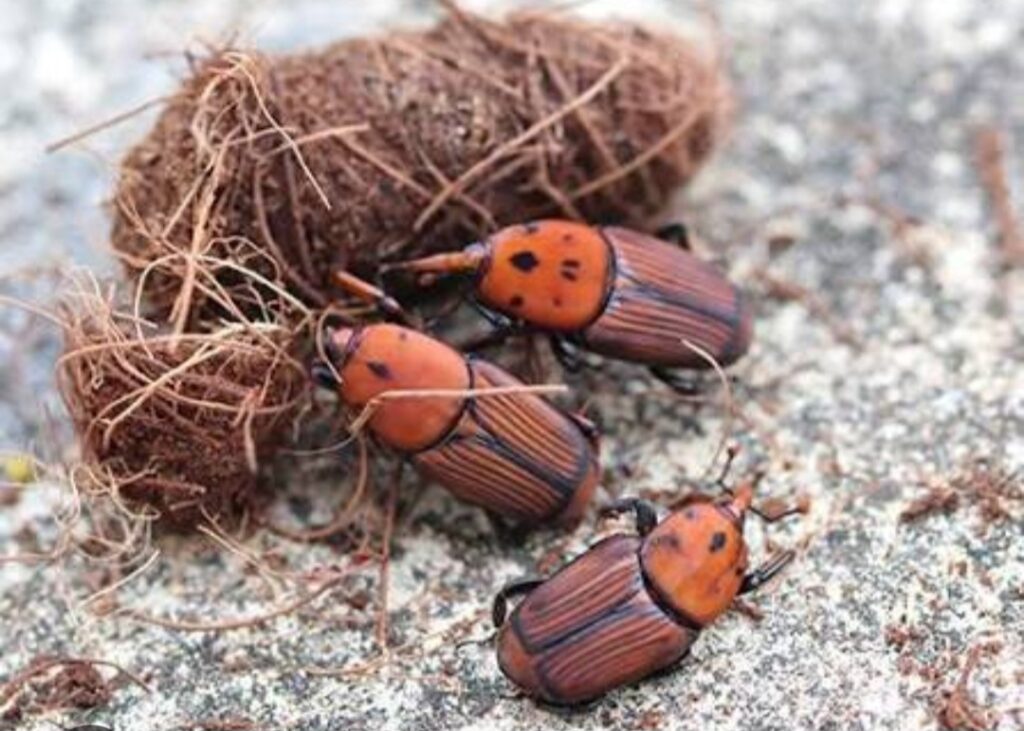
Palm weevil (Rhynchophorus ferrugineus)
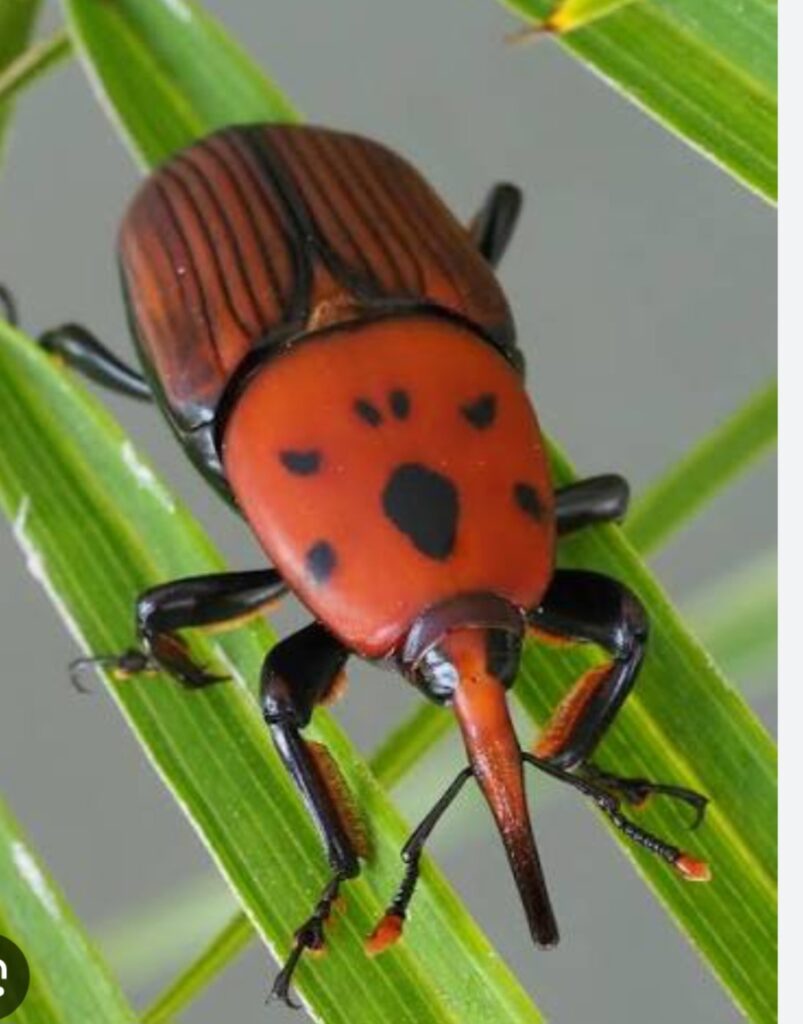
The palm weevil Rhynchophorus ferrugineus is one of two species of snout beetle known as the red palm weevil. This red palm weevil can either be Asian palm weevil or sago palm weevil. The adult beetles are relatively large, ranging between 2 and 4 centimetres (1 and 1+1⁄2 inches) long, and are usually rusty red in colour. Apart from this, many colour variants exist and have often been classified as different species ( for example., R. vulneratus). Palm weevil larvae can excavate holes in the trunks of palm trees up to 1 metre (3.3 ft) long, thereby weakening and eventually killing the host plant. As a result, the weevil is considered a major pest in palm plantations, including the coconut palm, date palm and oil palm etc.
Rhynchophorus ferrugineus
SCIENTIFIC CLASSIFICATION
Rhynchophorus ferrugineus belongs to the Phylum: Arthropoda, Class: Insecta and
Order: Coleoptera. Apart from this, other variants of the red weevil include;
Cordyle sexmaculatus Thunberg, Calandra ferruginea Fabricius, Rhynchophorus pascha v. papuanus Kirsch,
Rhynchophorus indostanus Chevrolat, Rhynchophorus signaticollis Chevrolat,
Rhynchophorus pascha v. cinctus Faust, Rhynchophorus ferrugineus v. seminiger and
Rhynchophorus signaticollis v. dimidiatus etc.
The red palm weevil originate from tropical Asia, and has spread to other parts of the world like Africa and Europe, up to the Mediterranean, Malta, Italy (Tuscany, Sicily, Campania, Sardinia, Lazio, Marche, Puglia and Liguria), etc
It is one delicacy found in many tropical countries. They are large beetles, with hard shiny shells. Most types are black but the one found across the Asian continent is dark red with black markings. The weevils life cycle is in about 5 stages. They spend months as larvae and then pupae – like large, fat white worms. They exist as what might be called ‘grubs’.
They do not look very pretty, and they inhabit and infest palm trees like date palms, coconut palms and ornamental etc.
TYPES OF PALM WEEVILS
All palm weevils are officially classified into four types. They are edible weevils, found on almost every continent. Their larvae, and to a lesser extent the adult beetles, are deliberately farmed and harvested all over the world. Recently, in Thailand, more industrialized production of the weevils are carried out. But for many centuries till now, native people using tree felling techniques pick up the larvae from the logs.
Some of the edible Palm Weevils include;
AFRICA: Rynchophorus phoenicis
AMERICAS: Rynchophorus palmarum
ASIA: Rhynchophorus ferrugineus Papua
NEW GUINEA: Rhynchophorus bilineatus etc
SPECIES OF PALMS ATTACKED BY RED PALM WEEVILS
All species of red palm weevil have been reported to attack about 19 palm species and it is the worst such pest in the world. They are reported to have attacked coconut in Southeast Asia, in several Middle Eastern countries, they are reported to have attacked date palm. They are also found in Africa and Europe where they are reported to have been imported with infested planting material. In the Mediterranean region, they are reported to have severely damages Phoenix canariensis. They have now infested almost all coconut-growing and date palm (P. dactylifera) -growing countries.
Some other hosts plants attacked by R. ferrugineus
include: Areca catechu, Arenga pinnata, Borassus flabellifer, Brahea armata, B. edulis, Butia capitata, Calamus merrillii, Caryota cumingii, C. maxima, C. urens, Chamaerops humilis, Cocos nucifera, Corypha umbraculifera, C. utan, Elaeis guineensis, Howea forsteriana, Jubaea chilensis, Livistona chinensis, L. decora, Metroxylon sagu, P. sylvestris, Roystonea regia, Sabal palmetto, Trachycarpus fortunei, Washingtonia filifera, and W. robusta.
In the case of date palm, it has been reported that the weevil prefers the ‘Sukkary’ cultivar of date palm.
Host palm species like W. filifera and Chamaerops humilis may be moderately resistant to the red palm weevil.
The red palm weevil usually infests palms younger than twenty years. While the adult causes some damage through feeding, it is the burrowing of the larva into the heart of the palm that can cause the greatest mortality of trees.
The larvae are known in the Vietnamese language as đuông dừa (“coconut beetle-larva”). “Sago worms” reported from other countries (e.g., East Malaysia, New Guinea) refer to different, related species of Rhynchophorus.
LIFE CYCLE AND STAGES OF DEVELOPMENT OF RPW
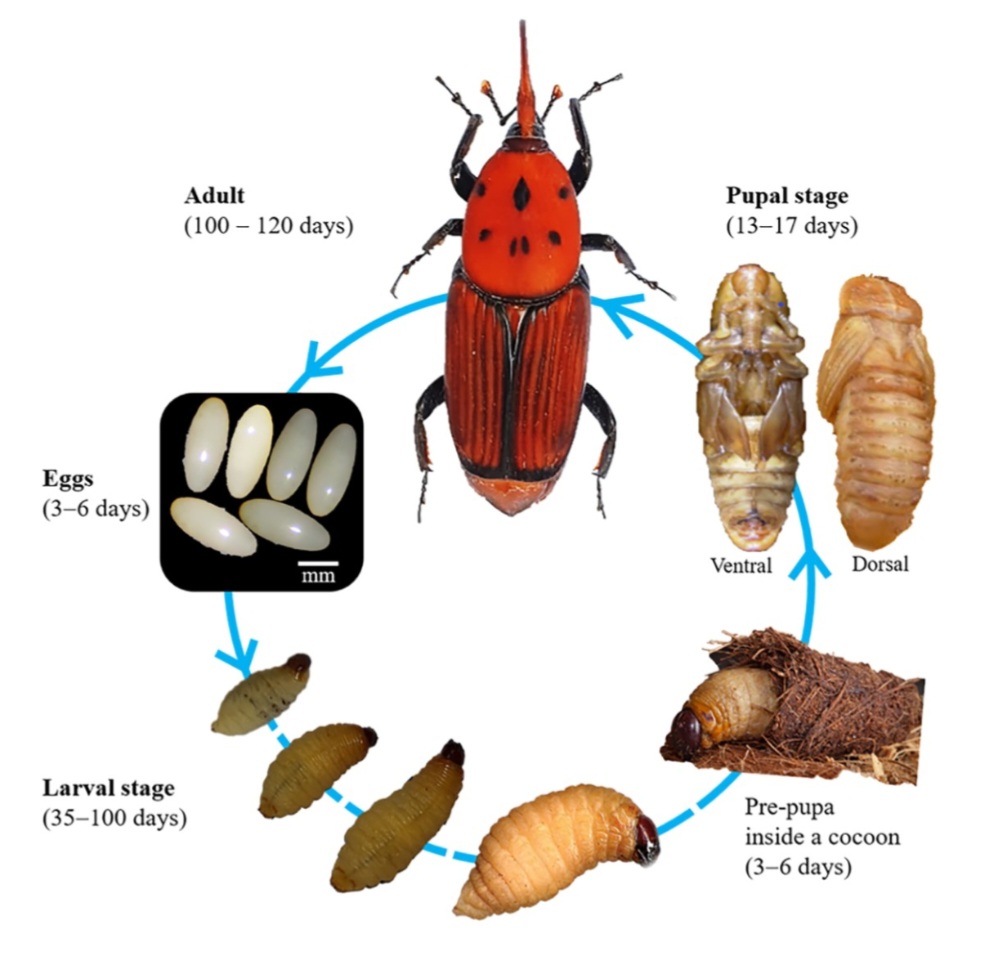
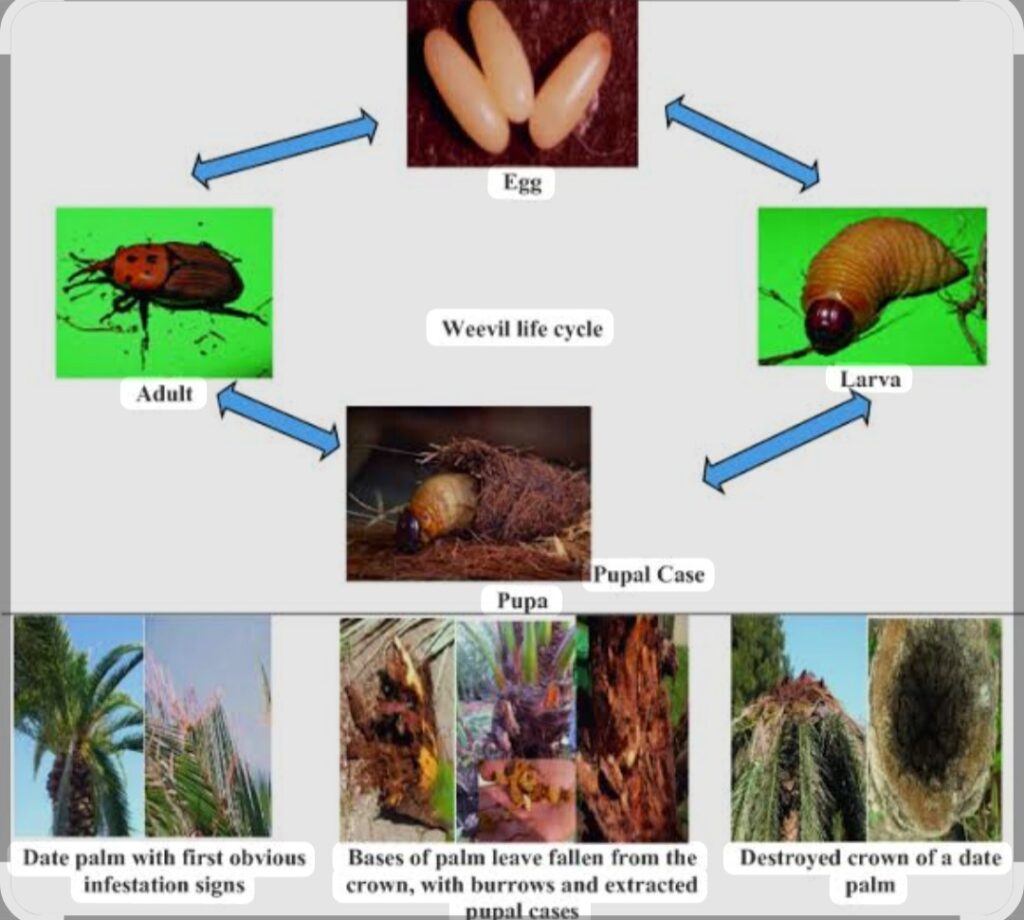
The life cycle of the red palm weevil start from the eggs laid, which develop to form the larva to the pupal case, then to pupa and the final stage is the adult stage.
A. EGG LAYING STAGE
After fertilization, the adult female can lay between 300 and 500 eggs. The eggs are creamy white, shiny, and oblong, approximately 3 mm long. These eggs are usually laid on new growth, especially in the crown of the palm, at the base of young leaves, or in open lesions on the plant. They also lay in holes they creat while searching for food, or take advantage of the cracks or wounds in a recently cut palm. When the egg hatches, a white, legless larva emerges. The larva feed on the soft fibres and terminal buds, tunneling through the internal tissue of the tree for about a month. The larvae can occasionally grow to a length of 6 to 7 centimetres (2+1⁄2 to 3 inches). At pupation, the larva will leave the tree and form a cocoon built of dry palm fibers in leaf litter at the base of the tree. The total life cycle takes about 3–4 months.
B. OVIPOSITION STAGE
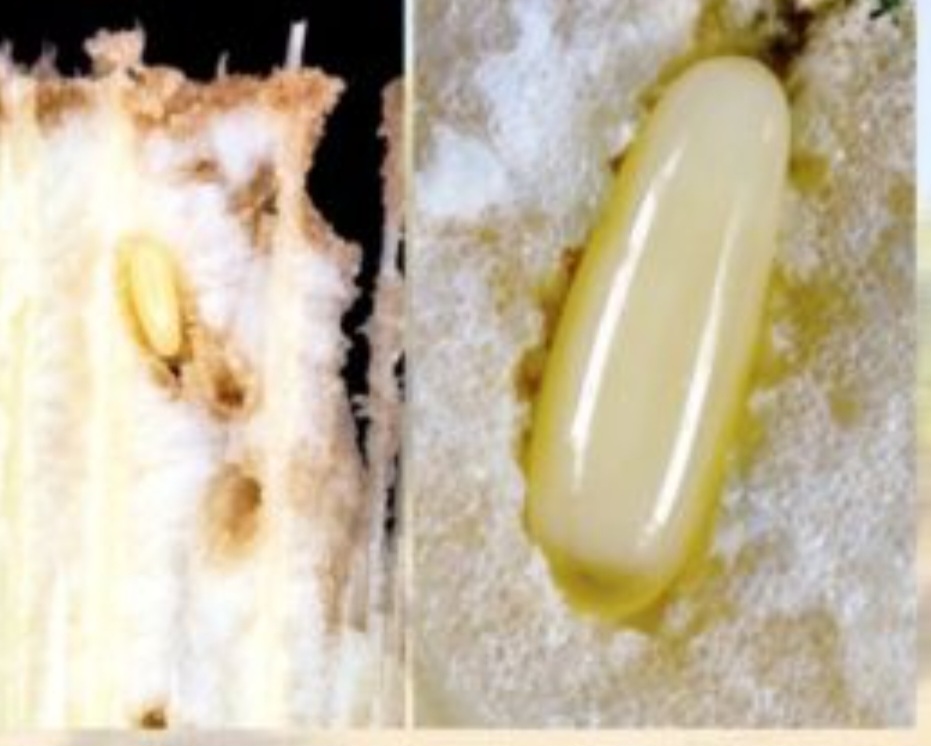
At oviposition, females bend upward and the tarsi are anchored to the tissue with the spines of the third pair of legs to push the ovipositor into the tough palm tissue. After laying, the female protects and secures the eggs with a secretion that rapidly hardens around the eggs. On average, females produce 210 eggs per clutch, most of which hatch over a period of 3 days. The eggs are white, cylindrical, glossy, oval shaped, and measure 1 to 2.5 millimetres (3⁄64 to 3⁄32 in). The back of these eggs possess special ‘gill cover’ structures that provide the developing insect with oxygen.
C. LARVAE STAGE
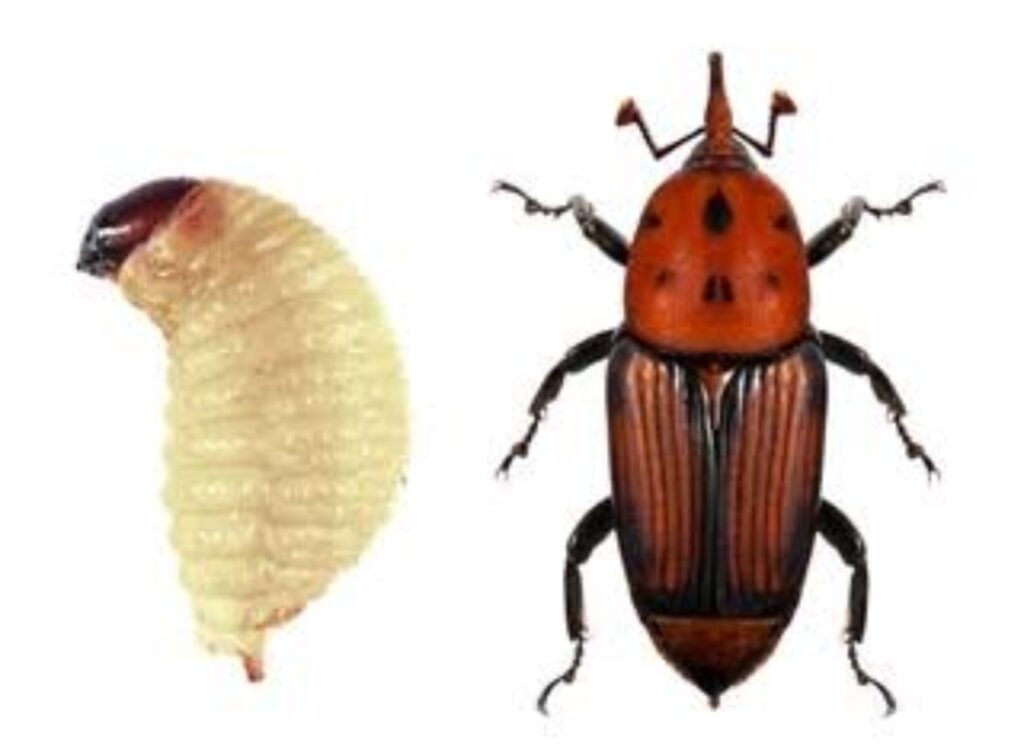
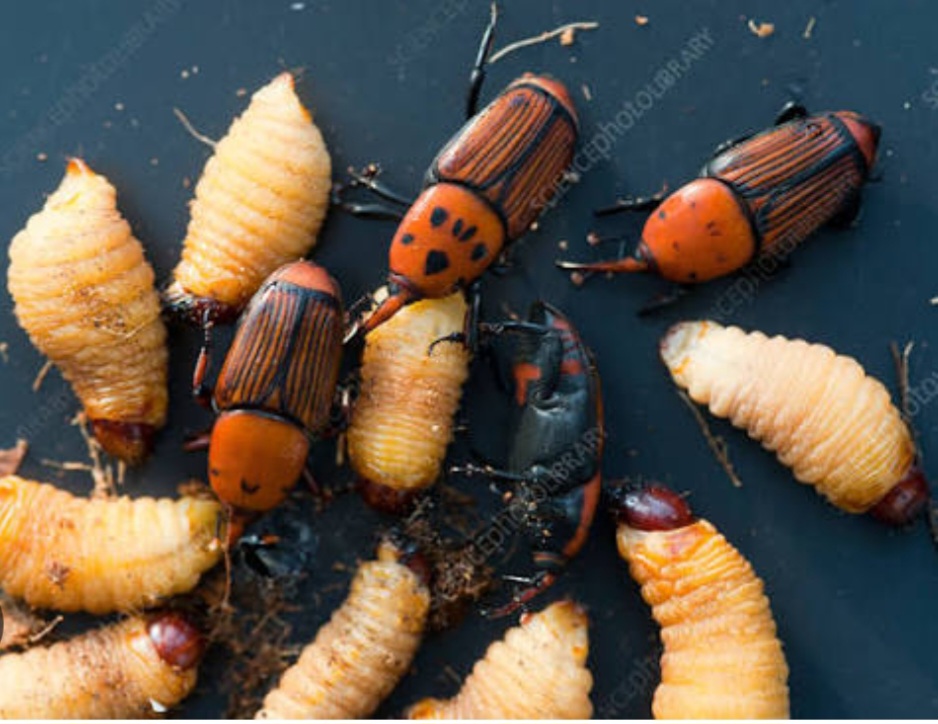
The neonate larvae are yellow-white in colour, segmented, legless, and have a chitinous head capsule that is darker brown in colour than the rest of the body. They are up to 5 cm in length and causes damage by feeding on the palm’s soft tissues. They have powerful horizontal conical jaws which they use to burrow from the axils of the leaves to the crown, where they feed voraciously. Upon completion of larval development, the larva will emerge from the trunk of the tree, and build a pupal case of fiber extracted from the galleries inside the palm. The larva will then undergo metamorphosis into an adult. The larva will also weave a pupal case at the base of the palm fronds within the frond itself or at the centre of the base of the plant.
D. PUPA STAGE
Develops inside a tough, elongated, cylindrical cocoon made of fibrous strands from the palm. The pupa is red-brown to black and the future adult’s appendages are visible.
E. ADULT STAGE
The pupa develops to form the adult weevil which possesses wing to fly.
The adult red palm weevil prefer to attack palms that are already infested or weakened by other stress factors. They also colonize healthy palms.
They are excellent flier and can travel great distances.
USES AND BENEFITS OF THE RED PALM WEEVIL
i. Larvae of Rhynchophorus ferrugineus are considered a delicacy in Southeast Asian cuisine. In some regions, however, larvae farming is strictly prohibited to prevent the potential devastation of plantation crops. The grubs can be toasted as found in the Asian palm weevil in Laos and eaten.
ii. The larval grub is considered a delicacy in Vietnam. The larvae are usually eaten alive with fish sauce.
iii. The larva can be cooked, toasted, fried and steamed.
iv. They are eaten with sticky rice and salad or cooked with porridge.
v. Palm weevils are excellent low cost sources of essential nutrients.
vi. They have low carbon footprint if farmed as a commercial enterprise.
vii. In Ghana, Palm weevils serve as a traditional meal for natives of most rural societies (especially within the southern sector) but are not farmed for consumption.
viii. Palm weevil farming is a cost-effective enterprise in terms of supplies and labour.
ix. The larvae reaches maturity within three to four months and can be harvested for consumption – very rich in protein.
x. The farming technique is cost effective and environmental friendly as it utilize agricultural waste as a resource and enhance food security.
xi. The mash used in rearing the larvae is rich in nutrients, therefore, used in compost making and can be sold as compost for crop farmers in amending infertile soils.
xii. Farmers do use the hollowed palm logs burrowed by the larvae, after six months, as containers for gardening and growing ornamental plants.
xii. Weevil larvae can be eaten fried, boiled, roasted or even raw. As they’re 10-30% fat, they do not need oil to cook and will caramelise in their own juices, becoming golden-brown and crisp.
xiii. To avoid exploding larvae, it is advised that they are sliced open a bit before cooking. Just like piercing the film in the microwave.
Palm weevil larvae are good source of lipids, proteins, amino acids and minerals.
DESCRIPTION OF RED PALM WEEVILS
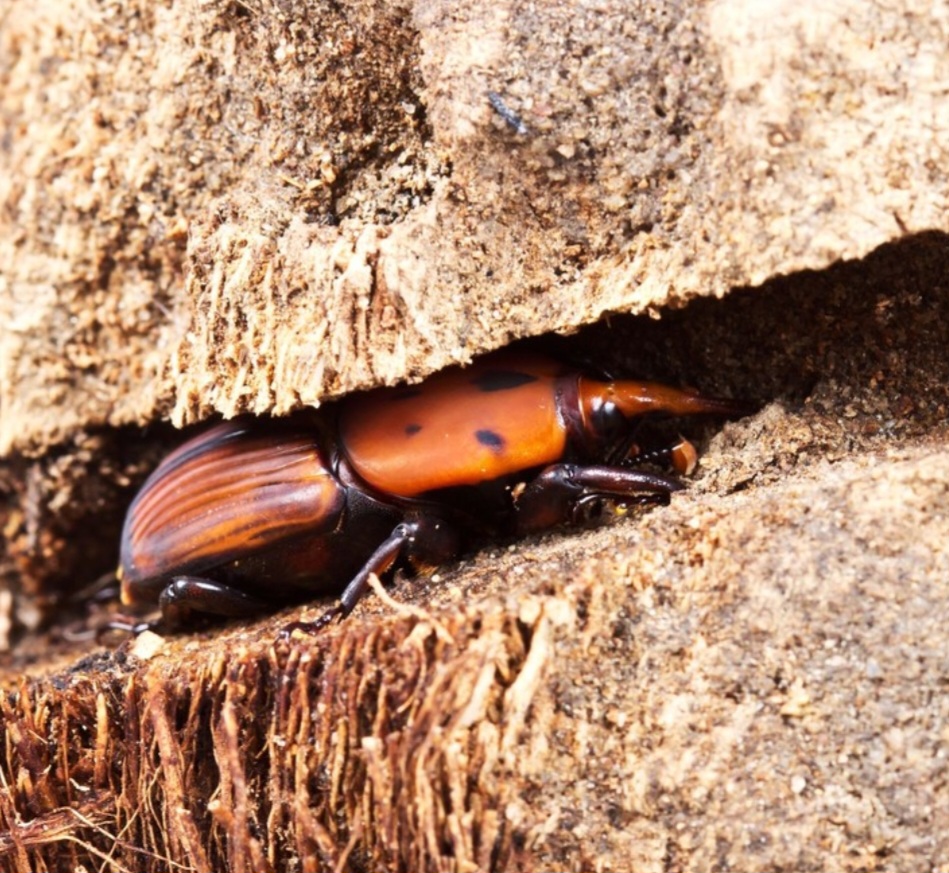
The red palm weevil (Rhynchophorus ferrugineus) is a large, reddish-brown beetle with a long snout, reaching up to 4 cm in length. It has a four-stage life cycle. They lay creamy-white eggs which hatch to form the larvae. The larvae are legless, white in colour with a distinct brown- chitinous head and with powerful jaws. They grow to be large, up to 50 mm or more, and are characterized by their segmented, tapering body. These larvae are the damaging stage, feeding inside the palm trunk and creating frass-filled mines. They pupae to form a tough, fibrous cocoon.
BEHAVIOUR AND HABITAT OF THE LARVAE
i. FEEDING: They feed voraciously on the soft tissues of the palm’s meristem or leaf bases.
ii. MOVEMENT: They burrow and move within the trunk and upper parts of the palm tree.
iii. PUPATION: When ready to pupate, the mature larva will exit the palm and construct a cocoon of palm fibers, or it may pupate inside the damaged tissue of the trunk.
THE ADULT
The adult weevil formed after pupation is a major pest of many palm species. Their larvae bore into the trunk and consume the soft tissues, often leading to the palm’s death.
SIZE: Body length typically ranges from 2 to 4 cm, with females slightly larger than males.
APPEARANCE: They are reddish-brown in colour, but there is significant variation in markings, including dark spots or a dark body with a single red stripe.
ROSTRUM: The head has a long, thin snout, or rostrum, which is a characteristic of the weevil.
FARMING THE WEEVILS
Palm weevils can indeed be raised in large numbers fairly easily using old tree trunks and plastic tubs. The farming involves setting up a breeding environment with a special diet, introducing a male and female weevil pair, and allowing them to reproduce in a controlled, cool, and clean space.
The larvae can be harvested after about 30–40 days, when they have reached the desired size. For the rearing of the weevils, outdoor palm logs or indoor transparent breeding boxes filled with a nutrient-rich mixture, like ground palm stalk and a soybean-based feed can be used.
TYPES OF FARMING RPW
RPW can be farmed using two major methods. The indoor and outdoor farming methods.
A. INDOOR FARMING
For indoor, this is a controlled farming practices, where transparent breeding box are used. The setup involves; provides a controlled, cool, and clean indoor environment.
ADVANTAGES OF INDOOR FARMING
i. Allows for easy monitoring
ii. Prevents external predators, and
iii. Provides a consistently stable environment, leading to higher yields.
DISADVANTAGES OF INDOOR FARMING
i. Requires initial investment in a suitable box and a consistent, cool environment with temperature between 16.7-23.9°C.
FEEDING
Artificial diet: A mix of ground palm stalk, soybean, corn, and other ingredients are used for compounding the diet.
ADVANTAGES OF ARTIFICIAL DIET
i. Consistent and controllable nutrient source, which can be supplemented with vitamins and minerals for optimal development.
DISADVANTAGES OF ARTIFICIAL DIET
May require some experimentation to find the most effective recipe.
HARVESTING IN INDOOR REARING METHOD:
Extract larvae after 30-40 days using sieving or handpicking. This is a predictable and high-yield harvesting schedule. But it is disadvantageous in the sense that it requires careful handling to avoid disturbing eggs or younger larvae.
OUTDOOR FARMING PRACTICES
For outdoor, this is a traditional farming practices where palm trunks are used. It involves the use of fresh palm logs or trunks as a breeding site. The logs should be placed in a shady, cool area.
ADVANTAGES OF OUTDOOR FARMING PRACTICES
i. It utilizes a natural and readily available material.
ii. More cost-effective setup.
iii. Lower initial cost compared to the indoor method.
DISADVANTAGES OF OUTDOOR FARMING PRACTICES
i. Weevils may be more difficult to locate and control compared to an indoor setup.
ii. Subject to environmental variables like weather and predators, which can affect growth and yield.
iii. Lower yield per trunk compared to an indoor container.
HARVESTING IN OUTDOOR REARING METHOD
Harvest larvae after 40-45 days by extracting them directly from the trunk.
CONDITIONS FOR SELECTION OF REARING METHODS
If the farmers priority is a high-yield, consistent harvest and have the resources for a controlled environment, indoor farming is the best. But if the farmer needs a lower-cost, more natural method and are willing to accept a more variable yield, outdoor farming is suitable.
Regardless of the method choosen, provision should be made for a diet rich in protein, such as a mix of soybean, corn, and palm.
PRODUCTION
Starting with just one batch of palm weevil larvae allows farmers to begin farming with minimal financial risk while still generating a profit. The setup costs are low, the maintenance is manageable, and the potential for growth is substantial.
BREAK DOWN OF THE FINANCIAL POTENTIAL OF PALM WEEVIL LARVAE FARMING, STARTING FROM A SINGLE BATCH AND GRADUALLY SCALING UP TO 100 BATCHES.
NOTE: using the conversion rate from XAF to NGN ( Nigerian currency)
( 1 XAF. = 2.61 NGN)
( 5 XAF. = 13.6 NGN)
Starting with 1 BATCH:
Average Production: 800 grams
Revenue from Fresh Larvae: 8,000 XAF =20,880 NGN
Revenue from Breeding Pairs: 5,000 XAF = 13,050 NGN
Total Monthly Revenue: 13,000 XAF = 33,930 NGN
Monthly Expenses: 4,020 XAF = 10492.2 NGN
Monthly Profit: 8,980 XAF = 23,437.8 NGN
This modest profit from a single batch demonstrates the business’s potential. It’s a low-risk entry point, allowing farmers to learn the ropes of palm weevil larvae farming.
Scaling Up to 5 BATCHES:
Total Monthly Revenue: 65,000 XAF
Monthly Expenses: 20,100 XAF
Monthly Profit: 44,900 XAF
With 5 batches, farmers can increase their profit fivefold, making a noticeable impact on their income.
Expanding to 20 BATCHES:
Total Monthly Revenue: 260,000 XAF
Monthly Expenses: 80,400 XAF
Monthly Profit: 179,600 XAF
As farmers expand to 20 batches, significant growth in profits will be experienced.
Growing to 50 BATCHES:
Total Monthly Revenue: 650,000 XAF
Monthly Expenses: 201,000 XAF
Monthly Profit: 449,000 XAF
Reaching 50 batches is a major milestone. At this scale, farmers business will generate substantial income, enabling further investment and expansion.
Achieving 100 BATCHES:
Total Monthly Revenue: 1,300,000 XAF
Monthly Expenses: 402,000 XAF
Monthly Profit: 898,000 XAF = 2,343,780 NGN
At 100 batches, farmers have built a highly profitable and sustainable business. With a monthly profit nearing 900,000 XAF (that is 2.3million naira) , the possibilities for further growth and diversification are endless.
SCALING UP: STEPS TO GROW FROM 1 TO 100 BATCHES
i. START SMALL: Farmers should begin with 1 batch to learn the basics of palm weevil larvae farming. This low-risk start allows farmers to gain experience without a significant financial commitment.
ii. GRADUAL EXPANSION: Increase the farming operation to 5 batches. This step-by-step approach helps farmers manage growth while increasing their revenue and profits.
iii. CONTINUED GROWTH: Move to 20 and then 50 batches as a confidence level and expertise grow. At this stage, farmers will have a strong foundation for a profitable business.
iv. FULL-SCALE OPERATION: Finally, expand to 100 batches. At this level, the farming operation will be generating substantial income, providing opportunities for reinvestment into other agricultural ventures.
REINVESTING PROFITS: EXPANDING INTO OTHER AGRO VENTURES
Once farmers have established a successful palm weevil larvae farming operation, the profits earned can be reinvested into other agricultural fields such as; crop farming, livestock, or agro-processing. The income generated from the palm weevil larvae farm can be the seed capital for further diversification.
PREDATORS, DISEASES, AND PARASITES OF RED PALM WEEVILS
a. PREDATORS
R. ferrugineus is predated upon by Chelisoches morio
DISEASES
R. ferrugineus is infected by a cytoplasmic polyhedrosis virus and Metarhizium pingshaense,
PARASITES
R. ferrugineus is parasitized by Heterorhabditis indicus, Hypoaspis spp., Praecocilenchus ferruginophorus, Scolia erratica, Steinernema carpocapsae, and Steinernema riobravis.
SYMPTOMS OF INFESTATION
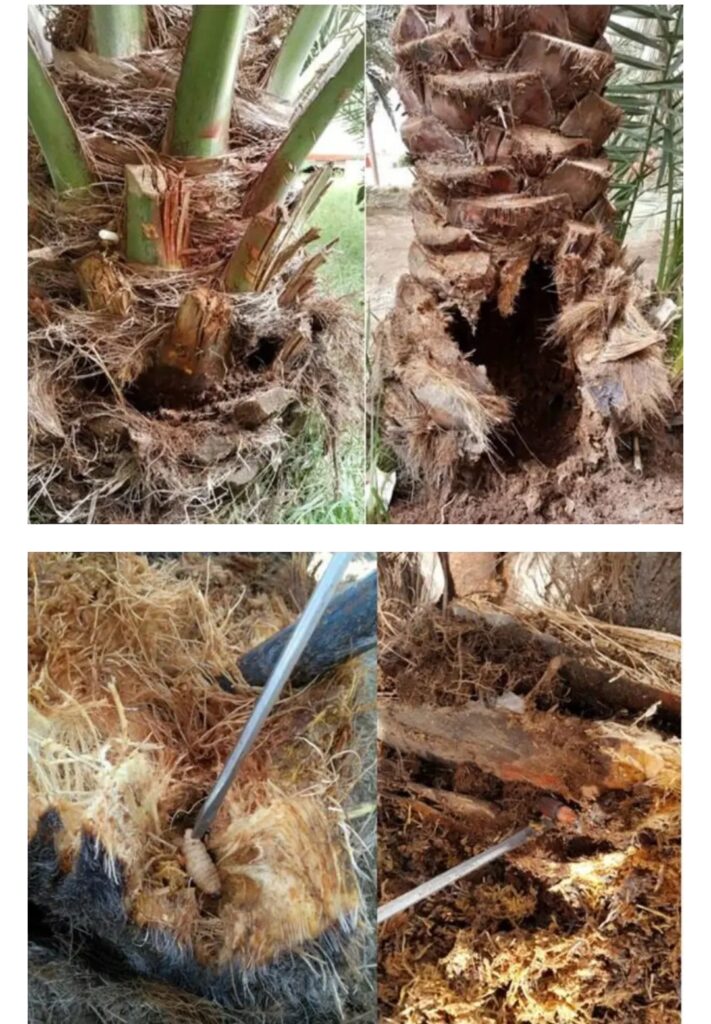
The infestation of the pest can result in yellowing and wilting of palms, and eventual death of the affected plant. The crown wilts first, and lower leaves will follow, due to damage to vascular tissue. Major symptoms such as crown loss or leaf wilt are usually only visible long after the palm has become infested. Secondary infections of opportunistic bacteria and fungi may occur within damaged tissues, accelerating decline. By the time these external symptoms are observed, the damage is usually sufficient to kill the tree, and the infestation may have been present for six months or longer. In high-density infestations, sounds of the larvae burrowing and chewing can be heard by placing one’s ear to the trunk of the palm. Recent research has been conducted using electronic listening devices or dogs trained to recognize the scent of weevils or palm decay to detect infestations at low densities earlier in the process.
PREVENTIVE AND CONTROL MEASURES FOR RED PALM WEEVILS
PREVENTIVE MEASURES FOR RED PALM WEEVILS
1. AVOIDING MECHANICAL DAMAGE: As the weevil prefers to lay its eggs in softer tissues, avoiding mechanical damage to plants can help to reduce infestation.
2. TARRING OF WOUNDS: Tarring wounds after pruning a plant of dead or old leaves can reduce the probability of infestation.
3. PROPER DISPOSAL OF PLANT PARTS: The movement of plant material such as husks, dead leaves, or untreated coir from infested to uninfested areas is not recommended.
4. USE OF INTEGRATED PEST MANAGEMENT (IPM ) METHODS: Strategic methods of RPW-IPM system can be employed to control the weevil. The main components of the RPW-IPM measures include:
(i) regular inspection of palms to detect infestations,
(ii) capture of adult weevils using food-baited pheromone traps (both
(i) and (ii) contributing to pest surveillance),
(iii) preventive and curative chemical treatments, and
(iv) removal/eradication of severely infested palms.
These RPW-IPM components are complemented by phytosanitary (quarantine) measures to regulate the
movement of planting material, and by capacity building and extension activities.
5. REMOVAL OF BREEDING SITES: Apart from the above measures, natural breeding sites of the weevils should be removed, particularly in enclosed gardens and fields.
6. AGRONOMIC PRACTICES: Agronomic practices such as field sanitation, palm density, irrigation, and frond and offshoot removal should be carried out.
7. USE OF BIOLOGICAL CONTROL AGENTS: Effective biological control agents like fungi and nematodes can be adopted to control the weevils. These control agents can reach the pest in their hideout.
8. REGULAR PRUNING: Trimming palm trees regularly to prevent the formation of a suitable environment for the weevil.
9. MAINTAIN CLEANLINESS: Removing agricultural waste around palm trees, as they can be a haven for insects.
CONTROL MEASURES FOR RED PALM WEEVILS
i. Setting of traps for attracting and destroying the weevils. Traps containing sex pheromones can attract the weevil and limit its spread.
ii. Hard pruning as a way of fighting
iii. Treatment of the palms : It has being reported that treated phoenix palm recovered after being attacked by the weevils.
Studies show that this insect is attracted by ethyl acetate, 2-methoxy.4.vinylphenol, gamma-nonanoic lactone, 4SSS-ferrugineol, 50H and 4me-9-5Kt.
iv. PERIODIC MONITORING: Conduct periodic examinations of palm trees to detect the presence of the insect in the early stages.
v. USE OF PESTICIDES: Spray recommended insecticides around the bases of the palms and in the affected holes.
vi. Get rid of the infected palm tree correctly to prevent the spread of the insect.
ORGANIC AND CHEMICAL CONTROL OF THE RED PALM WEEVIL
ORGANIC CONTROL OF THE RED PALM WEEVIL
i. Using beneficial nematodes to eliminate weevil larvae.
ii. Using insect pathogenic fungi as a biological control method.
CHEMICAL CONTROL OF THE RED PALM WEEVIL
i. Use appropriate chemical insecticides such as fenitrothion and deltamethrin.
ii. Spray pesticides directly on the affected areas to ensure the elimination of the insect.
CONTROL OF THE WEEVIL IN DATE PALM
The main control method is through the application of a systemic insecticide. Insecticide is usually applied through a funnel about 5 centimetres (2 inches) above the infested area of the trunk. The red palm weevil can be monitored using pheromone lures and alternative forms of control use field sanitation and mass trapping with traps baited with pheromone and plant derived semiochemicals. New alternative technologies using semiochemicals and bioinsecticides are being developed to attract the weevils to a point source and kill them. Another management technique is to drench the base of palm fronds with the entomopathogenic fungus Metarhizium robertsii (syn. M. anisopliae, Entomophthora anisopliae), or Beauveria bassiana. An Italian company claims to have developed a microwave collar that can be used to sterilize individual trees. For early detection, bioacoustic analysis may be implemented by inserting a sensitive microphone into the tree and recording any produced sounds. These sounds are analyzed by digital signal processing and artificial intelligence to decide whether they are generated by palm weevils.
Also, some palms have natural defense against this weevil. The palms are discovered to possess RNA interference (RNAi, a kind of gene silencing) is a defense system in many host-pathogen systems. RNAi shows promise as a breeding target when breeding palm for RPW resistance.
In summary, red palm weevil larvae farming offers a unique opportunity in agriculture. It is affordable, scalable, and highly profitable, making it an ideal starting point for aspiring farmers. It requires low startup costs and gradually, it can result into an integrated commercial farming system.

Okay, so I checked out okatmvn based on a friend’s rec. It’s got some interesting stuff happening over there. Definitely worth a look if you’re into this kind of thing. Check it out for yourself at okatmvn
Hi,
Thank you for introducing okatmvn to supremelights. We will surely check it out.
Hope you find supremelights post useful. If you have any aspect of agriculture you want us to address, please, contact us.
Thank you.
Bye
Spot on with this write-up, I really assume this website needs much more consideration. I’ll probably be again to read much more, thanks for that info.
Hi blaklink website,
Thank you for reading through supremelights post. We are grateful to you. Please, if you have any aspect of agriculture you want supremelights to address, contact us.
Thank you once again.
Bye
Lots of pesticides which are effective against the pests and does not harm the plants is available in the market. I would suggest to go through pest control company for best results. Correct fertilizers and pestcides are very important.
Hi Gautam
Thank you for reading through supremelights posts. One of the greatest challenge faced by farmers is pests and how to control them. Choosen agrochemicals is very easy but knowing how to apply, at the right quantity might be challenging. Read articles on agrochemicals of your choice and how to apply them on supremelights posts.
Please, if you have any aspect of agriculture you want supremelights to address, contact us. And if you need more advice on how to calculate the right amount of agrochemicals to apply for crop and livestock production, contact us
Thank you. Bye